Keep Your Eye On The Ball

Before the advent of the personal computer, summer days were spent at Graham Park, Skelly School, or some other ball diamond.  Those were days when baseball was undisputed as Amercia’s favorite game.

I enjoyed the games of “work up,” homerun derby, or whatever as long as it had a bat and a ball.  The many years I spent coaching my son through his little  league years were time consuming but very enjoyable.

As Papa, I am now watching my granchildren, and my advice to them is the same as it was to my children:  Keep your eye on the ball!  I had to remind a grandson of this a couple of weeks ago when a basketball rebounded off of his eye.  “Carson,” I said, “that is not what I meant when I said keep your eye on the ball.”

Over the years I’ve talked to some of the better hitters about technique.   Almost without fail, they have said the secret to getting consistent hits is vision:  You have to see the ball.

Seeing the ball means focusing on the seams of the ball and recognizing the spin.  Pitches can be identified by recognizing the rotation.  To help explain this, you can see a graph at this link.

One way to learn how to identify the curve ball is to stand behind a batting cage and watch a pitcher throw fastballs.  This may sound strange, but identifying what it isn’t helps you learn to identify what it is.
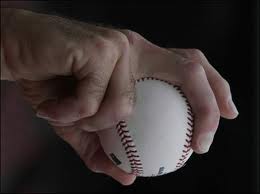
This is the technique Paul used when he was warning the Christians at Galatia.  They had been given the standard of truth, and Paul said they were to measure the “different” gospel against the pure doctrine.  They were to study and recognize the fastball theology they had been taught, so they would not be led astray by the strange spin of a curveball.

A comment by Joe Garagiola can serve as a thought to keep you thinking:  Nolan Ryan is pitching much better now that he has his curveball straightened out.  Was Joe putting a spin on his words or was he just stating a fact?

Three Cheers for the Nihilarians

A nihilarian (nick-el-arian) is a person who deals with things lacking importance.  I thank God for the people who are willing to do the tasks that may seem to be insignificant.

Unless you are an avid golfer, you might place caddies in the nihilarian category.  You could have the mistaken notion that all a caddy does is carry a bag full of clubs.  A good caddy is beneficial to the golfer because he knows the course; he can give advice; and, he can help with the mental aspect of the game.

I think most people fail to see the importance of nihilarians.  Because they are willing to attend to the small details of life they keep them from mushrooming into big problems.

This is the case with Robert.  He is willing to stay behind, so others can go ahead.  Each Sunday, he checks to make sure the lights are out, the doors are locked, and only then does he leave the building.

Then, there is the significant role of the ladies who come early to prepare communion and the ladies who work in the nursery–far too often people like these go unnoticed.  I say three cheers for the nihilarians.  Without you, my job would be much more difficult.

Romans 16 contains a list that names people who played this type of a role in the life of the Apostle Paul.  If not for the fact that Paul wanted to express his gratitude for these people, they would be anonymous to  history.

The profound importance of nihilarian-like gifts was emphasized in the teaching of Paul.  He wrote in I Corinthians 12 that  those parts of the body that seem to be weaker are indispensable.  These gifts and these people are indispensable, necessary and an essential to the health of any church or organization.

Here’s a thought to keep you thinking:  Who is it that makes your life a little easier, and when was the last time you expressed your appreciation to him or to her?  Let the nihilarians in your life know that they’ve been noticed.

Tree Rings

A tree is such a common sight, that we rarely consider how uncommon it is.  In the spring when the saplings begin to appear, we may pause briefly to reflect on childhood adventures—tree houses, gunny sack swings, and puppy love initials deeply etched in the dark colored ridges of once skin smooth bark.

Trees are utilitarian—they serve and fulfill many of our needs.  Due to its thorny disposition, Osage Orange was idealized in the past century as fence material.  Oak has been the wood of choice to decorate the living quarters of many homes, and baseball enthusiasts are thrilled when they hear the exhilarating crack of an Ash-made bat launching a baseball into the depths of center field.

But, utilitarian is an insufficient adjective.  Unique is perhaps a more adequate description.  A tree, you see, never really dies.  Even though a tree may be harvested, milled, and kiln dried, it is reborn every time a craftsman touches it.

This remarkable aspect of the tree is often overlooked.  A good example of this is the community or school orchestra.  After hearing a stirring rendition of Bach or Beethoven, the concert attendee may comment on the beauty of the stringed section.  If, however, there were no trees, there would never have been a violin or a fiddle; and, what about the music that reverberates from these stringed instruments?  Do we hear the sound of the strings alone, or is it the life of the wood that lends its vitality to these artistic endeavors?

The life after death potential of a tree is almost unlimited.  The first  Psalm speaks about a tree planted by the rivers of water, that brings forth its fruit in its  season, whose leaf also shall not wither; and whatever he does shall prosper.  The roots of this tree run deep and the fruit it bears is seasonal and sweet.

Long after we die, and we are little more than a memory, the fruit of our influence will live on.  What will your influence be?  Will it be the sweet and melodious sound of a violin or will it be an unwanted round of chagrin?

I hope this thought keeps you thinking.

Floccinaucinihilipilification

No the title of this article is not a typo.  It is a term that has the distinction of being one of the longest words in the English language and one of the most difficult to pronounce.  Floccinaucinihilipilification is defined as the act of esteeming something to be valueless.

Due to the nature of my work, I meet people from all walks of life.  Sometimes I am asked to help them with their personal and peculiar situations.  Low self-esteem is at the root of some of these problems.

Those who deal with issues of low self-esteem may spend too much time in self-floccinaucinihilipilification.  Their life is a mirage of self-deception that leaves them empty and hollow.

One of Aesop’s Fables comes to mind when I think of self-esteem.   It is the story of the Ass and the Lion’s skin.  One version of the story is:  An Ass once found a Lion’s skin which the hunters had left out in the sun to dry. He put it on and went towards his native village. All fled at his approach, both men and animals, and he was a proud Ass that day. In his delight he lifted up his voice and brayed, but then everyone knew him, and his owner came up and gave him a sound cudgeling for the fright he had caused. And shortly afterwards a Fox came up to him and said: “Ah, I knew you by your voice.”

While you can draw many principles from this story, I think it speaks to people who are not comfortable in their own skin.  This can be the result of childhood relationships.  If a person came from a family in which the relationships were close, strong, and positive, their self-esteem was nurtured.  If on the other hand, their family of origin was one of constant criticism and negative feedback, they may struggle with self-esteem.

How does a person begin to lift his self-esteem?  The first step is to become aware of your thoughts.  Negative thoughts that ruminate on your weaknesses and flaws are detrimental to your well-being.  Reframe these thoughts and focus on solutions and the positive aspect of your life. Instead of measuring your worth in pounds, weigh it in the value of a smile; see strength in acts of kindness, not bulging biceps; and see beauty in gracious words, not Estee Lauder.

The second step is to consider the potential of your relationship with God.  Some of the most uplifting words in the Bible are:  Behold what manner of love the Father has bestowed on us, that we should be called children of God (I John 3:1).  Think about those words–God wants to identify you as one of His children.

One way you can help another person with their self-esteem is to embrace Jesus’ principle: Love your neighbors as yourself (Matthew 19:19).  Why not lend a hand, so you can lift a life out of despair?  Diane Loomans captured the essence of this principle when she wrote:

If I had my child to raise all over again,
I’d build self-esteem first, and the house later.
I’d finger-paint more, and point the finger less.
I would do less correcting and more connecting.
I’d take my eyes off my watch, and watch with my eyes.
I’d take more hikes and fly more kites.
I’d stop playing serious, and seriously play.
I would run through more fields and gaze at more stars.
I’d do more hugging and less tugging.

I hope you esteem this article as being a thought worth thinking.

.

Getting A Grip On Happiness

There are times when I read the words of Jesus, and I wonder about the stated principle.  When Jesus said treat others like you want them to treat you, I used to think His words were a quid pro quo principle.  After reading some research, I’ve come to realize how beneficial those words can be to me.

Living the Golden Rule and voluntering can enhance a person’s sense of well-being.  A study found that 41% of us volunteer an average of 100 hours a year with the following results:

  • 68% of volunteers agree that volunteering “has made me feel physically healthier
  • 92% report  it “enriches my sense of purpose in life
  • 89% report it “has improved my sense of well-being,”
  • 73% that it “lowers my stress levels,”
  • 96% that it “makes people happier,”
  • 77% that it “improves emotional health,”
  • 78% that it helps with recovery “from loss and disappointment”

Typically, people who give of themselves to others have less trouble sleeping,  and they experience less anxiety, less helplessness & hopelessness.  They also report better friendships and social networks, and sense of control over chronic conditions than people who are more self-centered.

Each year, Stephen Post updates his, It’s Good To Be Good, research.  Post says:  ….as one achieves a certain shift from selfishness to concern for others, benefits accrue.   His research suggests that a person may feel good when he gives a financial gift to an individual or a cause; however, the benefits of helping others are most pronounced in direct person-to-person “hands on” activities.

When we embrace the words of Jesus and begin to live the Golden Rule, a satisfying life is within our reach.  According to Post, one way to elevate happiness is to reach out in helping behaviors and contribute to the lives of others. That happiness in turn elevates giving, which in turn elevates happiness. The two fuel each other in a circular fashion – a classic feedback loop.

The words of Dr. Albert Schweitzer leave us with a thought worth thinking: The only ones among you who will be really happy are those who have sought and found how to serve.

Playing Second Fiddle

Let the hype begin!  Today is Super Bowl Eve and the airwaves are full of football, football, and more football.  When football aficionados go to bed tonight, they will hang their stockings on the chimney with care in hopes that a win will soon be there.

While I am not a huge fan of either the Patriots or the Giants, I’ll probably cheer a little harder for Eli, his offensive line and the rest of the team.  I hope you noticed that I mentioned the seldom-credited offensive line.

Usually the offensive line is not mentioned unless a player jumps offside or gets called for a hold.  They are the perennial second fiddlers of the world of football.

Second fiddle can be a very important position.  A good example of this is Ernie Adams.  To be honest, today is the first time I have ever heard the name Ernie Adams.  In the story I just read, Adam’s is described as one of Bill Belichick’s closest advisors.  This second fiddler is the secret weapon of the Patriots.

As I was thinking about the important role of playing second fiddle, I found a comment by the celebrated maestro, Leonard Bernstein.  He was asked which instrument in the orchestra would be the most difficult to play.  Without hesitation, Bernstein said:  Second fiddle. I can always get plenty of first violinists, but to find one who plays second violin with as much enthusiasm or second French horn or second flute, now that’s a problem. And yet if no one plays second, we have no harmony.

The words of President Harry Truman can be applied to the concept of playing second fiddle:  It is amazing what you can accomplish if you do not care who gets the credit.

History has been full of people like Ernie Adams, we just don’t hear much about them.  They are more concerned with the melody and harmony of life than they are with the world acclaimed solos.

If it had not been for another second fiddler, the course of Christianity may have taken a different path.  Barnabas is the man of whom I speak.  He was called the son of consolation.  He was the guy who would pat you on the back and say:  You can do it.  Come on, I’ll help you get it done.

The most notable person that Barnabas helped was the Apostle Paul.  Because of his past history, Paul was shunned by most Christians.  Not so with Barnabas, he welcomed him with open arms.

The confirmation and encouragement of Barnabas empowered Paul as an individual and Christianity as a whole.  Barnabas wasn’t concerned with who was going to get the credit, he just wanted to accomplish something for the Cross.

Henri Nouwen may have captured the essence of playing second fiddle when he said:  When we honestly ask ourselves which person in our lives means the most to us, we often find that it is those who, instead of giving advice, solutions, or cures, have chosen rather to share our pain and touch our wounds with a warm and tender hand. The friend who can be silent with us in a moment of despair or confusion, who can stay with us in an hour of grief and bereavement, who can tolerate not knowing, not curing, not healing and face with us the reality of our powerlessness, that is a friend who cares.

I hope you take the time to think a thought about who it is that you can help today or some where along the way.

The Smooch of Forgiveness

There are many symbols and legends that give accounts of people moving from death to life.  The mythological phoenix was a bird that would rise from the ashes to new life.  Another account is the biblical story (Numbers 17) of Aaron’s rod.  This was a dead piece of wood that budded to new life.

The death to life cycle is what we witness each Spring as the cold hard days of winter are vanquished by the warmth of the sun and flowers begin to dot the greening landscapes.  Hope, once again, is reborn.

In a few months people will return to their gardens.  The soil will be cultivated and seeds planted in eager anticipation of a succulent harvest.

A part of this process is the need to weed.  Tiny seeds will feed on the fertile soil, take root, and and become a nuisance.

The need to weed should also be at the top of a person’s daily agenda.  The fertile ground of the mind can be a garden spot of beauty or one that is beastly in nature.  It can blossom into the beauty of forgiveness or be parched with the dryness of bitterness.

The SMOOCH project addresses this need with their global documentary and online forgiveness initiative.   This project profiles individuals who have found the humanity in the very persons they thought they could never forgive.  Their team of  filmmakers and photographers hold  Forgiveness Shoots around the world that focus on both the offender and the offended.   These heart-touching stories culminate in the forgiver and the forgiven giving one another a kiss on the cheek.

Jesus made a turn-the-other-cheek comment that should be enough to keep you thinking:  Here’s another old saying that deserves a second look: ‘Eye for eye, tooth for tooth.’ Is that going to get us anywhere? Here’s what I propose: ‘Don’t hit back at all.’ If someone strikes you, stand there and take it. If someone drags you into court and sues for the shirt off your back, giftwrap your best coat and make a present of it. And if someone takes unfair advantage of you, use the occasion to practice the servant life. No more tit-for-tat stuff. Live generously (Matthew 5:39).

Who Will It Be?

I usually have the TV on of a morning while I’m getting ready for work.  Wednesday morning a story was aired about the Kauffman Foundation and the ad they will run during the Super Bowl.

The question they ask is one of motivation:  Will it be you?  The ad and the related material they plan to make available is designed to encourage the entrepreneurial spirit among our aspiring youth.

As I thought about the challenge of the Kauffman Foundation, I thought of two people from history who get little mention.  The first is William Booth the founder of the Salvation Army, and the second is Clara Barton who founded the Red Cross.  Both of these individuals saw a need and they stepped up and stepped out to make a difference in the lives of the suffering.

When I think of the legacy of Booth and Barton, I ask the question:  Who will it Be?  Who will be the next person to step up with a new program to alleviate suffering?

Hundreds of years before Christ was born, the prophet Isaiah recorded a message in the form of a question:  I heard the voice of the Lord saying, “Whom shall I send? And who will go for us?”   Isaiah did not let the question die as a weakening echo.  He captured the essence of the plea, and He responded:  Here am I, send me.

That question has been asked in one form or another for many centuries.  Jesus restated it in the form of a mandate to His disciples.  We are told that when He saw the people as sheep having no shepherd.  He instructed the disciples to pray for more workers in the harvest.

The question of the Kauffman Foundation is a thought worth thinking–Will it be you?  Will you be the next person to take a risk for the benefit of others?  Will you be the one who will help shepherd the sheep. 

If you pray the prayer that Jesus spoke of, why not do it in front of a mirror?  If you do, you may see the answer to your prayer.

A Slip of the Tongue

It was Benjamin Franklin who said:  A slip of the foot you may soon recover, but a slip of the tongue you may never get over.

Slip of the tongue moments can be rather funny.  I remember the time a grandmother proudly spoke of her granddaughter’s academic pursuits:  My granddaughter is getting involved in ocean pornography.  I laughed, knowing that she meant oceanography.

I remember a slip of the tongue moment from several years ago.  Frank Marley misspoke and I laughed and then teased him a little.  Frank’s reply is something that has stuck with me:  Don’t take a man for what he says—take him for what he means.

Frank died in 1994, and I still have fond memories of him.  What I remember most is not his willingness to help around the church, but the way he communicated his values by living them.

These were values that were formed through the fire of the depression years and character born out of the turmoil of the world wars.  Tom Brokaw has described Frank and his peers as the greatest generation.

The values that defined this generation are the moral fiber of those that have followed.  Scottish minister Thomas Guthrie once said:   Religion is the mortar that binds society together; the granite pedestal of liberty; the strong backbone of the social system.

Just as crumbling mortar is a threat to the integrity of a building, anemic values weaken our social structure.  A position paper by the Institute for American Values issued warning several years ago:  as our social morality deteriorates, life becomes harsher and less civil for everyone, social problems multiply, and we lose the confidence that we as Americans are united by shared values.

The Institute says the symptoms of this decline are manifested in several ways:

• a spreading abdication of adult responsibility and an increasing acceptance of the adult as a perpetual adolescent

• an increased tolerance for self-centered and selfish behavior in all spheres of life

• a growing belief that success should be measured by how much money we have and how much we can buy

• a dramatic undermining of the distinction between right and wrong

• the loss of confidence in the possibility of public moral truth.

The Institute proposes a strategy for renewal and express it in several goals.  The most important, they say, is to revitalize a shared civic story informed by moral truth. Regarding our civic faith, our main challenge is to rediscover the democratic bonds that, amidst and because of our differences, unite us as one people. Regarding our public moral philosophy, our main challenge is to rediscover the existence of transmittable moral truth.

Solomon rarely committed a slip of the tongue, and people took him for what he said and for what he meant.  If society would heed his advice, the need would be met.  He said, a commitment to godly principles is essential if we are to walk the right path in life.

I hope this thought keeps you thinking.

Hide and Seek: A Moral Dilemma

9th Street Bridge

I stopped by the 9th street bridge yesterday morning about 5:45 and snapped the picture to the left.  When it comes to the relationship between light and darkness, this picture is worth a thousand words.

It has been said that darkness is the absence of light, and the power of these opposites on our moral choices has been the subject of much discussion.  Recent research  suggests that darkness creates a psychological feeling of secrecy that may lead to amoral behavior.  Whether it is closing the eyes during a game of hide and seek or wearing a pair of sunglasses,  the self-induced darkness can reduce our sense of morality.

Apparently the seclusion of darkness provides an incognito mentality that is expressed as, catch me if you can.  The more popular version is, what happens in Vegas stays in  Vegas.

This reminds me an of old Latin phrase: In absentia luci, tenebrae vinciunt.  Which means:  In the absence of light, darkness prevails.  I believe there is a connection between this statement and the Broken Window Theory.

This theory helps to explain some self-perpetuating problems.  Any part of  society that appears to be void of law and order can become  a  fertile seedbed in which the weeds of lawlessness grows.  As an example, a vacant building  that has a few broken windows that are not replaced will soon become a vacant building with many broken windows.  To keep this from happening, the small problems need to be addressed before they become big problems.

To accomplish this, we may benefit from the words of Paul who challenged people to cast off the darkness and to put on the armor of light (Romans 13).

Let me give you a thought to keep you thinking:  Could it be that darkness is not the absence of light, but it’s the absence of you?