Is It Who or Which?

For sake of clarity, some new verisons of the Bible have made their appearance on the shelves of bookstores.  An example of this is the New Kings James Version (NJKV).  It is an update of the King James Version(KJV) that was printed in 1611.  The KJV had quite a few archaic words that were updated in the NKJV.

This attempt at clarity has muddied the waters in a few places.  Phillipians 4:13 is one such case:  I can do all things through Christ which strengtheneth me (KJV).  In the NKJV which has been updated and changed to who (Christ who strengthens me).

While there is truth to both the KJV and the NKJV, I believe the use of who misses the point of Paul’s teachings.  No one doubts that we find strength in the who of Jesus Christ; however, the point is we are strengthened in the which or the doing of the Christian experience.

Case in point is the time Jesus went to the mountain to pray and the disciples went to the sea of Galilee to fish.  While He was engaging in prayer, the raging sea was about to swamp their boat.  This was a learning lab that involved 9 hours of whiching that would prepare them for future endeavors.

The design of the lesson was to teach them that Jesus is present even in the storms of life.  As He was drawing near to the boat, He saw them cowering in fear.  He quieted their fears, and calmed the sea with a few words:  Be of good cheer! It is I; do not be afraid.

Notice that Jesus said, It is I–present tense.  He is not a has-been-god of the past, or a hope-so-god of the future.  As Pslam 23 says, He is present–The Lord is my shepherd . . .

Here is a thought to keep you thinking.  It is the heartache of the past and the trials of the present that which you into shape to face the future.
Thoughtful or Thought-Filled?

I’m not sure that I’m a thoughtful person; however, I have no doubt that I am thought-filled.  My mind races from one thought to another at a speed, that even NASCAR can’t match.

If all these thoughts were positive and constructive, I’d be the envy of the world.  The trouble is that many of them are negative and destructive.

I’ve come to realize that either I control my thoughts or they control me.  Our thoughts are seeds that blossom into feelings and behaviors that make us either blooming idiots or citizens of substance.

Dick Tracy

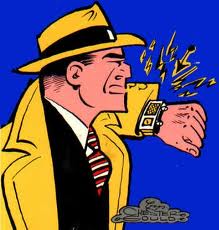
The increase in technology is directly connected to a decrease in thought-regulating quiet time.  Think with me for a moment about the rapid changes in society.  I can remember the Sunday edition of the paper and the watch-like apparatus Dick Tracy wore on his wrist.  Dick could be seen talking to a fellow detective with this device that was a pre-cursor to cell phones and video conferencing.  Most everyone thought this was far-fetched-thinking that would never happen in their lifetime, but we’ve gone from party-lines to cell phones with video capabilities in just a few short years.

And shortened years just might be the diagnosis, if we don’t learn how to slow down and still keep pace.  The question is:  How can we slow down, when the computer keeps us ramped up?

Here’s something I’m trying.  Every time I do a Google search, I pause just a second before I begin and say something positive and spiritual.  Prayers like this  have their roots in the words of the Apostle Paul:  Pray without ceasing (I Thess. 5:17); and in the thoughts of the old Quaker theologian, Rufus Jones:  Let a person’s inner being be fortified with a faith in God and all his creative powers are quickened, his marching strength is heightened and his grip on everyday things is immensely increased. It is as though he had tapped a hidden reservoir of power.

Let me share a few quick phrases that can be effective keyboard prayers:

·        Bless the Lord, my soul.

·        May Your will be accomplished in me.

·        Not my will, but yours.

·        Teach me. Guide me. Keep me

·        The Lord is the Rock of my salvation.

Instead of embracing the mentality of Atlas and trying to carry the weight of the world on my shoulders, I’m learning to use these mini-prayers as pace-setters as I walk with the Lord.

I think these words of Jesus from The Message provide a good summary of my thoughts:  Are you tired? Worn out? Burned out on religion? Come to me. Get away with me and you’ll recover your life. I’ll show you how to take a real rest. Walk with me and work with me—watch how I do it. Learn the unforced rhythms of grace. I won’t lay anything heavy or ill-fitting on you. Keep company with me and you’ll learn to live freely and lightly (Matthew 11:28-30).

I hope this thought keeps you thinking.

What’s In A Name

Most people who know me call me by the shortened form of my name.  Although my birth certificate reads, Stanley Lee Seymour,  most people call me Stan.   An etymological search of Stan reveals that it is Old English in origin and means rocky meadow or from the stony field.

Etymology, however, had nothing to do with the selection of my name.  Because my last name starts with an S, Mom and Dad thought it would be trendy for the first name of each of their children to start with an S.  My older brother’s name is Steve and my younger brother’s name is Brad.

Before he was born Brad’s name was going to be Stuart, but Mom was already having trouble calling Steve, Stan and Stan, Steve, so Stuart became Brad.

I think recent events show the power of a name.  Due to the bankruptcy of 2001, the name Enron is associated with corporate greed.  More recently, investment scams have come to be associated with the name Madoff.

Within the last couple of days, a new association has been given to the name  Schettino.  Captain Franceso Schettino has been accussed of dereliction of duty and cowardice.  If he was an officer in the United States military, he would be court-martialed.

In each of these examples, the absence of character was present.  For every ounce of character that Captain Schettio lacked, a pound of it was present in the cockpit of another captain.

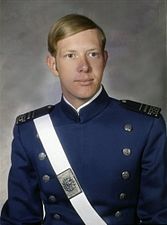
The name Chesley Burnett Sullenberger III or “Sully” is associated with courage and integrity.  When faced with tragedy, he made a quick assessment; and, he landed his jet on the waters of the Hudson River.  His heroic efforts made him a household name.

Even though he attended the Air Force Academy, his actions remind me of the Army Cadet PrayerMake us to choose the harder right instead of the easier wrong, and never to be content with a half truth when the whole can be won.

The disciplined life that Sully developed as a cadet, was on display on that cold January day of 2009.   Each of our military academies provide a daily regimen that builds the type of character and integrity that defines Captain Sullenberger.

The absence of character and the decline of morals was the focus of study by the Institue for American ValuesIf a central task of every generation is moral transmission, religion is a primary force in American life — historically, it has probably been the primary force — that transmits from one generation to another the moral understandings that are essential to liberal democratic institutions. Religion is especially suited to this task because it focuses our minds and hearts on obligations to each other that arise out of our shared createdness. By elevating our sights toward others and toward ultimate concerns, religious institutions help us turn away from self-centeredness . . .

I’ve been told that character is an Old English word that comes from the print shop and means the mark left behind.  Schettino or Sullenberger, what mark defines your name?

Here’s a thought to keep you thinking:  A good name is more desirable than great riches; to be esteemed is better than silver or gold (Proverbs 22:1).