Your Piece of the World

03world-puzzleWhether you live in the USA, England, Europe, Africa, or Asia, there is one thing you hold in common.  You and the rest of humanity want peace in your piece of the world–certainly, this is the case in El Paso, Texas, and Dayton, Ohio this morning.

I know I’ve grown weary of all the protests, murders, shootings, and rapes that I see on the screen of my TV.  The headlines of the newspaper are depressing with stories of theft, scandals, and abused children.

Here is what I am going to do in my piece of the world today. Instead of being, “overcome by evil, I’m going to overcome evil with good (Romans 12:21).”  I am going to try my best to, “pursue the things which make for peace and the things by which one may edify another (Romans 14:19).”  J.B. Philipps translated this same verse in these words:  “Let us concentrate on the things which make for harmony, and on the growth of one another’s character.”

Will you join me and make this your goal for today:

  • I will pursue and concentrate on bringing peace to my piece of the world.
  • When confronted with the off-key and unkind remarks of others, I will try to bring harmony to the situation.
  • I will do my best to be a positive presence in the life of those I encounter.

So what in the world are you going to do today?  I encourage you to bring peace to your piece of the world.

The Iconic Brain or Do Smartphones Make You Smarter?

brain-injury

In the world of information technology the term icon is about as outdated as a dial phone.  In the not so distant past, the images on the screen of your computer were called “ICONS.”  From a religious perceptive, the word means “a window to heaven.”  From the viewpoint of technology “ICON” was used in reference to a window to an application.

The ICON has been buried in the bone yard of outdated computer technology and replaced by the APP.  The birth of the APP has walked in step with the proliferation of smartphones.

A story in US News & World Report has examined a study on the correlation between finger and thumb dexterity and the development of the sensory processing component of your brain while using a smartphone.  Each part of your body, from the top of your head to the tip of your toes, “has a corresponding ‘processing area’ in the emotional center of the brain, a region known as the somatosensory cortex.”

This function of the brain is often referred to as “sensory processing,” and it is the ability of the brain to interpret the information it has received, so it can prioritize and emphasize the components of the data; decide how to understand what is going on; and, decide what you will do based on the information received and processed.

Researchers used an EEG to study the brain activity of 37 people while they were using their cell phones:

  • 26 were using touch-screen smartphones
  • 11 were sing traditional cellphones with keypads

The study was able to distinguish between the length of time the subject had owned a smartphone and the frequency with it had been used.  The change in the brain was associated more with how frequently the smartphone was used over a 10 day period than just owning the phone and using it periodically.

Here’s a thought or two to keep you thinking:

  • How can these findings be applied to your life?
  • Is it more important to pray for a long time every now and then or to have short frequent prayers every day?
  • How does your prayer life mold and reshape the sensory processing region of your brain?

Perhaps this is one of the reasons Paul instructed the Christian to “pray without ceasing.”


DDT: Harmful or Healthy?

DDT is an abbreviation for the pesticide known as dichlorodiphenyltrichloroethane that was banned in 1972 due to its harmful effects on the environment and its connection as a cancer-causing agent.  It was effective, but also deadly.

In recent years there has been a renaissance of interest and a growing fan-base in DDT.  This form of DDT (Dirt Detection Technology) is not considered deadly, but very effective and healthy.

DDT is now associated with the IBOT Roomba series of vacuum cleaners. It uses Dirt Detection Technology (DDT) to distinguish between the cleaner and dirtier areas of a room, so it can use its patented 3 stage cleaning system to deep clean where needed.

As I read about the properties of this property cleaning device, I thought of God’s 3 stage cleaning system:

  • The Holy Spirit: “He will convict the world concerning sin and righteousness and judgment (John 16:8).”
  • The Word: “All scripture is inspired by God and is useful for teaching the faith and correcting error, for re-setting the direction of a man’s life and training him in good living. The scriptures are the comprehensive equipment of the man of God and fit him fully for all branches of his work (2 Timothy 3:16-17).”
  • Prayer: “Search me, O God, and know my heart; Try me, and know my anxieties; and see if there is any wicked way in me, and lead me in the way everlasting (Psalm 139:23-24).”

Casual cleaning is not always enough to get the job done.  Instead of sweeping the dust under the carpet, we need to employ God’s 3 stage system of cleaning–DDT will get the job done.

Hold-up Time

lift-up-others-e1406121694759


When you hear someone speak of a “hold-up,” you probably think in terms of the chart below.


Wichita Annual Crimes

VIOLENT                  PROPERTY               TOTAL

2,871                               21,198                     24,069

Annual crimes per 1,000 residents

7.43                                 54.86                       62.29

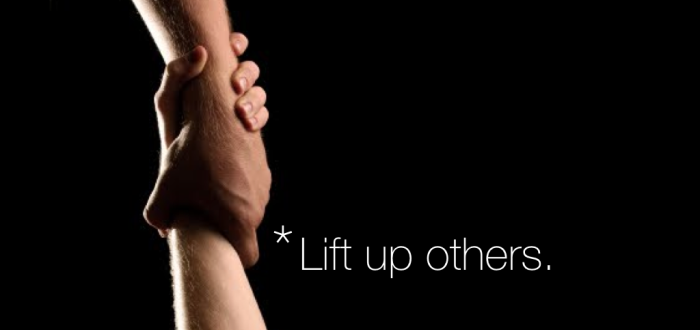
From the statistics above, it’s obvious that some people will try to “hold-up” their way of life by beating you down.  There is, however, another meaning associated with the phrase:   “Hold-up” can also mean to support or to hold-up in prayer.

In Exodus 17, you can see the physical and spiritual aspects of this are revealed.   The Amalekites, a group of nomadic raiders, had attacked the people of Israel.  While Joshua engaged the enemy in a physical battle, Moses, along with Aaron and Hur, fought a spiritual war on a nearby hill:  “So it came about when Moses held his hand up, that Israel prevailed, and when he let his hand down, Amalek prevailed.”  Moses eventually became so weary that he couldn’thold-up his hands, so Aaron and Hur responded by holding up his arms until the Israelites were able to finally defeat the Amalekites.

When Paul described a well-armed Christian, he also asked the Ephesians to “hold-up” his needs in prayer:

Therefore you must wear the whole armor of God that you may be able to resist evil in its day of power, and that even when you have fought to a standstill you may still stand your ground. Take your stand then with truth as your belt, righteousness your breastplate, the Gospel of peace firmly on your feet, salvation as your helmet and in your hand the sword of the Spirit, the Word of God. Above all be sure you take faith as your shield, for it can quench every burning missile the enemy hurls at you. Pray at all times with every kind of spiritual prayer, keeping alert and persistent as you pray for all Christ’s men and women.  And pray for me, too, that I may be able to speak freely here to make known the secret of that Gospel for which I am, so to speak, an ambassador in chains. Pray that I may speak out about it as my plain and obvious duty (Ephesians 6; J.B. Phillips).”

To quote Paul, I would ask that you “pray for me too.”


Note:  The resource for the crime stats is:  http://www.neighborhoodscout.com/ks/wichita/crime/

The Advantage

advantageFor a brief period of my professional life I was involved in sales. As part of my training, the company sent me to a week-long school to introduce me to the finer points of salesmanship.

Throughout the training, one phrase was emphasized time and time again: The advantage to you is . . . After making that statement to the prospective client, I would finish the sentence by highlighting the distinguishing characteristics of the product I was selling.

From a Christian perspective, you can complete the phrase several ways. The advantage to you is that by becoming a Christian, you can:
• Know Jesus as your Savior
• Be assured of a home in Heaven
• Find comfort in His Word
• Depend on the Holy Spirit for guidance
• Be reassured and find strength through prayer
• Have hope even in times of sorrow

Most viewpoints have both a positive and negative side to the argument. The real “advantage” can be understood sometimes by also considering the negative side: How would my life be different if I did not have a personal relationship with Jesus?

What are the positives and negatives of your life, and what are the advantages you’ve discovered?

A Call to Action

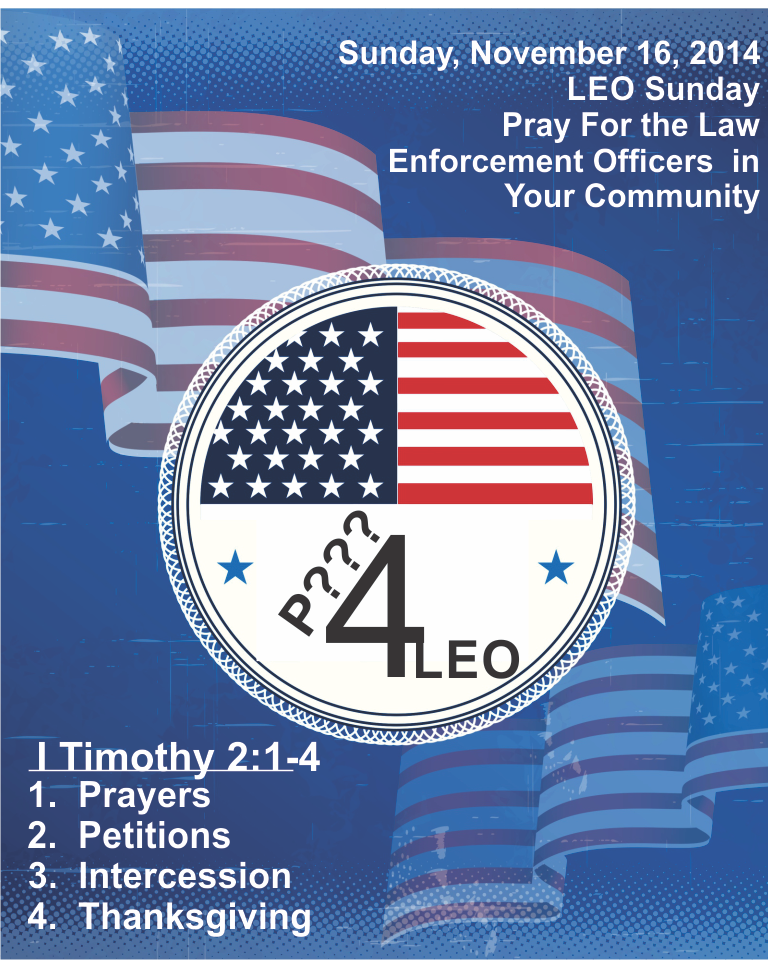
LEODue to recent events and what I perceive to be a heightened level of danger directed toward people who wear the uniform, I encourage you to pray for both our military personnel and Law Enforcement Officers (LEO).

Many faith communities will recognize and pray for the military on Sunday, November 9th to honor veterans in advance of Veteran’s Day (November 11th).

I ask you to join me and designate Sunday, November 16th as Pray 4 LEO Sunday. Feel free to copy the graphic on this page.

The theme verse I’ll use is I Timothy 2:1-4: “I urge, then, first of all, that petitions, prayers, intercession and thanksgiving be made for all people— for kings and all those in authority, that we may live peaceful and quiet lives in all godliness and holiness. This is good, and pleases God our Savior, who wants all people to be saved and to come to a knowledge of the truth.”

Please pass this on to pastors you know, your church, and through your email and social media (Facebook, etc.).

“. . . that we my live peaceful and quiet lives in all godliness and holiness . . .” and for the safety of those who protect us.

Essential Communication

scrabbleI would imagine that most everyone who reads this blog has a cell phone. Not so long ago, the cell phone was thought of as a convenience, but it’s now considered to be an essential device for daily communication.

In a sense, the same can be said for prayer. Some people think of it as a convenience, while others recognize its true importance. It is the essential means through which we communicate with God.

The importance of prayer is seen in the words of Philip Yancey: “If prayer stands as the place where God and human beings meet, then I must learn about prayer. Most of my struggles in the Christian life circle around the same two themes: why God doesn’t act the way we want God to, and why I don’t act the way God wants me to. Prayer is the precise point where those themes converge.”

Several years ago I began to use the word PRAY as an acronym to guide my quiet moments with God:

Praise: Sing praises to God, sing praises; Sing praises to our King, sing praises. For God is King of all the earth (Psalm 47:5-7)

Repent: Search me, O God, and know my heart; Try me and know my anxious thoughts; and see if there be any hurtful way in me, and lead me in the everlasting way (Psalm 139:23-24).

Ask: Be anxious for nothing, but in everything by prayer and supplication with thanksgiving let your requests be made known to God. And the peace of God, which surpasses all comprehension, will guard your hearts and your minds in Christ Jesus (Philippians 4:6-7).

Yield: Trust in the Lord with all your heart and do not lean on your own understanding. In all your ways acknowledge Him, and He will make your paths straight (Proverbs 3:5-6).

As Yancey said, “If prayer stands as the place where God and human beings meet then I must learn about prayer.” I hope this PRAY acronym will help you learn more about prayer, and help you spend more time using this essential means of communication.

Developing the Habit

consistency_quoteEven though he did not use the exact words each time, there are at least four distinct places where Paul calls you to a life of disciplined prayer:
• Pray without ceasing (I Thessalonians 5:17)
• Rejoicing in hope, patient in tribulation, continuing steadfastly in prayer (Romans 12:12)
• With all prayer and supplication, pray at every opportunity (Ephesians 6:18)
• Devote yourselves to prayer; stay alert in it with thanksgiving.

When you read the verses above are you overwhelmed? Do you wonder, “How can I pray without ceasing?” Does God actually expect me to do what Paul instructs these believers to do—pray constantly and consistently?

The answer is to this is yes and no. Practically speaking, it is impossible to be on your knees and in prayer every moment and second of life, but that isn’t what Paul calls you to do. I think Paul’s idea of prayer is to have an attitude of prayer.

You begin to maintain the habit of prayer when you “set your mind on things that are above, not on things that are on earth (Colossians 3:2).” How will you know when you are doing this?

A habit of prayer is being developed when you:
• Begin to live with a God-consciousness—everything you see and experience becomes a kind of prayer
• Are tempted, you immediately go to God and ask for His help
• See the good in someone or experience the beauty of nature, you thank the Lord for it.
• Meet someone, you have a concern for their spiritual well-being

Paul may had an extraordinary prayer life, but remember that he was still just an ordinary person; and, what Paul did, you can do as well. I encourage you to fine-tune your attitude of prayer by giving careful consideration to these words of Paul:

“Pray diligently. Stay alert, with your eyes wide open in gratitude. Don’t forget to pray for us, that God will open doors for telling the mystery of Christ, even while I’m locked up in this jail. Pray that every time I open my mouth I’ll be able to make Christ plain as day to them.
Use your heads as you live and work among outsiders. Don’t miss a chance to make the most of every opportunity. Be gracious in your speech. The goal is to bring out the best in others in a conversation, not put them down, not to cut them out. (Colossians 4 ~The Message).”

To get started, read the Scripture above with each meal you eat, and before you go to bed. Do it more than just today—practice it each day for the rest of this week.

God Willing

god_willing_mug-r7056888776fc48d6ba16762a3baf25d2_x7jgr_8byvr_324Over the last couple of years, I’ve noticed something about my mail box. It has more junk mail and very few letters. The reason for this is the advent of email.

In the early history of our nation, travel was difficult and communication a challenge, so people were excited when they received a letter in the mail. In the early 1800’s a Christian might end his letter with a postscript consisting of two letters: D.V.

These letters stood for a Latin phrase, Deo Volente that means: “God willing.” This idea is expressed in the book of James: “If the Lord wills, we will live and do this or that (James 4:15).” The principle of this phrase and this verse is that we should not live a self-directed life.

A clear concept of Scripture is that we should seek the will of God. To do this you should:
• Be willing to embrace God’s will for your life (Isaiah 6:8).
• Look to God’s Word as a guide (Psalm 119:105).
• Seek Gods will through prayer (Jeremiah 33:3).

As you follow the steps above, you may notice that when you take God’s Word in, your praise for Him will go up; your faith will go out; and, God will strengthen you as you walk in His will.

Pun, Puny, or Powerful;?

ernestThe character in the photo to the left is Ernest P. Worrell. A few years ago, Ernest provided quite a few laughs for people.

I’m not really concerned with the puns of Ernest, but I do have some interest in the prayers of earnest. When I think of my life and the prayer principles of Scripture, I wonder if my prayers are puns, puny, or powerful in comparison.

Do your prayers manifest the same sense of urgency and importance as those in Scripture? Can you see any resemblance in the verses that follow?
• Earnestly seek God and make your supplication to the Almighty (Job 8:5).
• Jairus “begged Jesus earnestly, saying, ‘My little daughter lies at the point of death. Come and lay Your hands on her, that she may be healed, and she will live’ (Mark 5:23).”
• Continue earnestly in prayer, being vigilant in it with thanksgiving (Colossians 4:2)
• Elijah “prayed earnestly that it would not rain; and it did not rain on the land for three years and six months (James 5:17).”

The simple thought and profound truth of the verse above, is explained for us in The Message: “Make this your common practice: Confess your sins to each other and pray for each other so that you can live together whole and healed. The prayer of a person living right with God is something powerful to be reckoned with. Elijah, for instance, human just like us, prayed hard that it wouldn’t rain, and it didn’t—not a drop for three and a half years. Then he prayed that it would rain, and it did. The showers came and everything started growing again (James 5:16-17).”

Is prayer a “common practice” in your life? Is it an earnestly practiced discipline or is it a ho-hum after-thought?