Zoned Out

As I was driving to Haysville on Tuesday to conduct a funeral, I drove past an AutoZone parts store.  As I read the sign, I thought:  AutoZone . . . that’s how I navigate my life.

If we would stop and think about our daily schedule, we could see many moments when we have been on autopilot.  Think with me for a moment about your daily routine.

  • When you get dressed, do you always insert the same leg first?
  • What about your shoes?  Do you always put a shoe on a certain foot first?
  • What other routines do you perform each day with little or no thought?

I’m afraid this can also be true of a person’s spiritual routine.  We get into an AutoZone where we do what we do out of habit instead of devotion.

It may be time to take your life off of autopilot and be more intentional for a day or two.  Instead of just doing whatever you do, pause and look for God along the way.  Solomon said it this way:  Trust God from the bottom of your heart; don’t try to figure out everything on your own.  Listen for God’s voice in everything you do, everywhere you go; He’s the one who will keep you on track  (Proverbs 3MSG).

I know that much of what a person does is because he is either right hand or left hand dominated.  It is an issue of coordination.  With this in mind, let me challenge you to be intentional by changing things up a little.  When you drink your coffee, pour the pot and drink from the cup using a different hand; and, when you do it, read the verse above.

Let me issue a warning:  This can be dangerous to your health.  I know from experience!  I ride about 6 miles on my exercise bike every morning.  The first time I tried to lift my coffee cup to my mouth with my left hand while I was pedaling, I almost crashed and burned.

Changing your routine may feel a little awkward at first, but I think it is beneficial.  When a person dispenses a ritual, his senses are keenley aware of the change.    By doing something different and trying something new there is a potential overlap into the spiritual realm of your life that allows you to see the presence of God in a fresh way.

I’ll wrap it up today with the words of David:  The LORD makes firm the steps of the one who delights in him; though he may stumble, he will not fall, for the LORD upholds him with his hand (Psalm 37:23-24 NIV).
The Habit of Excellence

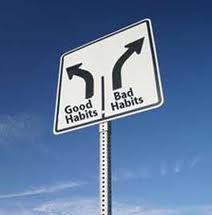
Ever wonder why we keep doing the  things that we know we should not do and do not want to do?  I give you a little 5 letter answer to this encyclopedic problem–habit.

I believe it was Aristotle who said:  We are what we repeatedly do. Excellence, then, is not an act, but a habit.  Repetitious behavior is a coin with two sides:  good habits and bad habits. 

Because they are so ingrained in our lives, habits are often performed unconsciously.  This means we give little thought to some of the things we do.  This auto-pilot mentality is either a wonderful servant or a worrisome master. 

Research has shown that old habits appear to lose some of their power when new habits begin to replace them.  The new habit is a positive detour that bypasses the old rut.  

According to Ryan and Markova we form new habits by considering our three zones of existence: comfort, stretch and stress. Comfort is the realm of existing habit. Stress occurs when a challenge is so far beyond current experience as to be overwhelming. It’s that stretch zone in the middle — activities that feel a bit awkward and unfamiliar — where true change occurs.

Any time we try to kick a habit and develop a new skill, we can expect to experience some discomfort.  If you are right-handed, try writing or eating with your left hand.   Unless you are ambidextrous, it will feel a little odd or clumsy.

The same is true with any change in your routine.  At first it will seem awkward.  Several years ago I was told that I should substitute rice or almond milk for regular dairy milk.  The first time I tasted the substitute, my tastebuds shouted:  YUK!  I did a quick reframe of my response and said:  It isn’t milk, but it tastes pretty good for what it is.  And, I’ve done fine with it ever since.

New habits are not developed overnight.  At a minimum, I suggest 40 days of consistent practice as a start and for long-term success I think 3 months dedicated to the new routine is important.

Paul contrasted the habits of the flesh and the habits of the Spirit in Romans 6: I am using an example from everyday life because of your human limitations. Just as you used to offer yourselves as slaves to impurity and to ever-increasing wickedness, so now offer yourselves as slaves to righteousness leading to holiness.  When you were slaves to sin, you were free from the control of righteousness.  What benefit did you reap at that time from the things you are now ashamed of? Those things result in death!  But now that you have been set free from sin and have become slaves of God, the benefit you reap leads to holiness, and the result is eternal life.  For the wages of sin is death, but the gift of God is eternal life in Christ Jesus our Lord. 

I hope this thought keeps you thinking:  Where in your life do you need to intervene, so you can begin a healthy new routine?

Chump or Champ

He stands 6′-11″, weighs 211 pounds and wears number 7, but Billy Cundiff’s luck ran out on Sunday.  During the season he scored 84 points and was accurate 76% of the time, but his missed field goal attempt led, in part, to the Raven’s loss.

Even though Cundiff is the 4th best kicker in the NFL, he will be remembered more for the kick he missed than for the 28 he made.  Like an elephant, Cundiff will never forget, and this will weigh on him just as heavily.

Fans were outraged because Cundiff missed the kick.  At the time, few people were aware of a scorekeeper’s mishap that altered his preparation.

Cundiff, like most kickers has a well-ordered sideline sequence that prepares him for his on-field performance.  He  uses the down and distance information on the scoreboard to walk him through his routine.  On Sunday, Cundiff worked through his first-down prep and checked the scoreboard.  Then he went through his second down prep and looked at the scoreboard.

Suddenly there was confusion on the sidelines.   Coaches were shouting “field goal,” but Cundiff still thought it was 3rd down.  The scorekeeper had failed to advance the scoreboard stats,  and it indicated 3rd down when it was 4th down.  Cundiff was forced to break his routine, rush on the field, and he missed the uprights.

Cundiff illlustrates the need for a healthy routine and what happens when we break it.  A mentor of mine, Raymond Barber, told me that, You don’t lose your religion in a blowout.  You lose it in a small leak.

Small changes go unnoticed until the cumulative effect is felt.  A person can benefit from a disciplined life or suffer the consequences of neglect.

A disciplined routine prepared Samuel Grady for the 1984 Olympics where he won a gold medal in track and field.  Grady has said, All through my professional and amateur career, I worked a little harder and trained a little extra.  I was the first one at practice and the last to leave. 

Let me share a definition of discipline:  Doing the things that need to be done even when you don’t feel like doing them.  Whenever you’re doing the things that need to get done, keep the words of  Solomon in mind, Whatever your hand finds to do, do it with your might (Eccl. 9:10).

I hope this thought keeps you thinking.