Grumpy or Gracious?

grumpyWhenever I read the opening verses of Psalm 92, the number 1,440 flashes through my mind.  1,440 is the number of minutes in a day, and Psalm 92 is a positive motivator on how to manage these precious moments:

It is good to give thanks to the Lord, and sing praises to Your name, O Most High. It is good to tell of Your loving-kindness in the morning, and of how faithful You are at night, with harps, and with music of praise.  For You have made me glad by what You have done, O Lord. I will sing for joy at the works of Your hands (Psalm 92:1-4).

Think about the words you spoke yesterday; was your vocabulary more grumpy than it was gracious?  How would your life be different if you would spend more time counting your blessings than tallying your slights?  Would you be happier and healthier?

Barbara Fredrickson, a researcher at the University of North Carolina, has examined the power of positive and negative thoughts. She has found that positive emotions enhance your sense of personal potential; opens your mind to new possibilities; and, they allow you to develop new skills and resources that add value to your life.

Fredrickson’s premise is a conformation of a principle from the Proverbs: Gracious words are a honeycomb, sweet to the soul and healing to the bones. ~Proverbs 16:24

Over the next week, I encourage you to use some of the 1,440 minutes of each day to put Psalm 92 to practice:

  • Focus on the blessing of God, and give thanks.
  • Whistle a tune, hum a favorite hymn, and sing a song of praise to God.
  • When you get up in the morning, start with a God is Able thought, and end your day by rehearsing the history of God’s faithfulness.
  • Begin and end each day with the following prayer:

May the words of my mouth and the meditation of my heart be pleasing in Your sight, Lord, my Rock and my Redeemer. ~Psalm 19:14

An Adventure in the Land of Why

maliLife is an adventure.  Some people seem to stumble their way through it, while others have the ability and agility to bob and weave their way through its obstacles.  Some people have the knack to fall face first into every mud hole that dots their path in life, while others can transform the sourest moments of life into a sweet experience.

Even though he could float like a butterfly, and sting like a bee, there were a few times Muhammed Ali felt the brute force of a punch that was akin to the kick of a mule. On March 24, 1975, Chuck Wepner introduced Ali to one of the universal laws of life:  Sooner or later you’re going to get hit by a punch you never saw coming!

Suffering is a thread that’s woven into the fabric of life, and it’s the sucker punch that can drop you to your knees.  

Peter said you should not, “be surprised when the fiery ordeal comes among you to test you as if something unusual were happening to you (I Peter 4:12).”

Even though suffering is anything but pleasant, James said to, “Count it all joy when you meet trials of various kinds, for you know that the testing of your faith produces steadfastness (James 1:2–3).” 

It’s important to note that James did not say that the suffering or trial is a joyful experience; instead, he said the joy comes in acknowledging the end result of the trial—steadfastness.  The situations that shake your faith are the ordeals that form a faith that’s unshakable.

Your faith is like your muscle tissue—to get stronger, it must be stressed.

In hindsight, Paul could see the boldly colored thread of hope in the tapestry of heartache.  He could see God’s purpose in the suffering he had endured: “We want you to know, Christian brothers, of the trouble we had in the countries of Asia. The load was so heavy we did not have the strength to keep going. At times we did not think we could live.  We thought we would die. This happened so we would not put our trust in ourselves, but in God Who raises the dead (2 Corinthians 1:8-9).”

“This happened”, so Paul would know that God is able and that He would enable him.

A Peak Behind The Clouds

double-rainbowTuesday morning, I was driving west towards Wichita and I was blessed with the beauty of a double rainbow. As the dazzling colors shone brightly against the distant backdrop of dark and menacing clouds, I was reminded that life is much like that storm.

Throughout a person’s life, he will experience the highs and lows; the sunny days and the threatening storms; and times of crippling sorrow as well as abundant joy.  Through all of these moments, there is always a rainbow: the promise of God’s presence and providence.

It was the promise of God’s presence and the hope of His providence that sustained the Apostle Paul in the many heartaches and trials that he endured:

I am at peace and even take pleasure in any weaknesses, insults, hardships, persecutions, and afflictions for the sake of the Anointed because when I am at my weakest, He makes me strong. ~2 Corinthians 12:10 The Voice

When the tough times come, and they will, remember to peak behind the clouds—God has a rainbow-full of promises just for you.

. . . when I form a cloud over the Earth and the rainbow appears in the cloud, I’ll remember my covenant between me and you . . .

Genesis 9:16 The Message

The Cadence of His Voice

cadenceSome people misinterpret the 10 Commandments and the principles of the New Testament as rigid walls erected by God to deny them access to the pleasures of life.  Nothing could be farther from the truth.

Whenever God says, “Thou shalt not,” it’s to keep you from stubbing your toe or skinning a knee.  Every time He say, “Thou shalt,” He’s inviting you to skip with joy and whistle a tune of happiness.

When you hear the cadence of His voice and walk in step with Him, you discover that He is your strength and shield.

Blessed be the Lord, because He has heard the voice of my supplications! The Lord is my strength and my shield; My heart trusted in Him, and I am helped; therefore, my heart greatly rejoices, and with my song I will praise Him (Psalm 28:7).

Integrity

integSometimes I’m asked to comment on the ills of society or to meet with an individual who is in need of counseling.  The common denominator that frequently links the two is a lack of integrity.  Whether it’s a politician, a musician, an actor, or an individual, the lack of integrity can be at the root of their problems.

Earlier today, I read about a sting conducted by the Tennessee Bureau of Investigation that focused on sex trafficking.  Two ministers were arrested in a sex for money scheme. The actions of these men is indicative of their lack of integrity.

Integrity is defined as an “adherence to moral and ethical principles; soundness of moral character; honesty.”  It is an important trait that should be highly valued, and it is a part of Warren Buffet’s screening process: “In looking for people to hire, you look for three qualities: integrity, intelligence, and energy. And if they don’t have the first, the other two will kill you.”

Buffet’s quote reminds me of the people of Berea and the manner in which they validated the ministry of Paul and Silas—they did an integrity check:

“The people of Berea were more receptive than they had been in Thessalonica. They warmly and enthusiastically welcomed the message and then, day by day, would check for themselves to see if what they heard from Paul and Silas was truly in harmony with the Scriptures (Acts 17:11).”

The Bereans didn’t take the teaching of Paul and Silas at face value.  They checked it to see if it adhered to the principles of Scripture.

Searching the Scriptures was a daily habit of these people, and I suggest that it’s a practice you should adopt as well.  When you read a passage of Scripture, I recommend that you ask yourself a couple of questions:

  • Is there a promise I can claim?
  • What lesson can I learn?
  • Is there a command I should obey?
  • Is there a sin I should avoid?
  • Is there a blessing I can share?

These questions will help you focus on the principles of the Bible and apply them to your life, so read them through; think them clear; pray them in; live them out; and pass them on.

Words of a Particular Kind

154451011How long would it take you to make a summary statement of your life?  How many words do you think it would take?

Robert Frost said he could sum up everything he had learned about life in three words: “It goes on.”  There’s a lot of truth to what Frost said, but it’s also true that what you say can determine how far you go in life and how your life “goes on.”

Mother Teresa was more concerned with the nature of your words than she was with the number of them: “Kind words can be short and easy to speak, but their echoes are truly endless.”  David, like Mother Teresa, was well aware of the power of the spoken word, and he prayed: “May my words and my thoughts be acceptable in your sight, O Lord, my sheltering rock and my redeemer (Psalm 19:14).”

When I think about David’s prayer, I’m left with a couple of questions:

  • Are my words and thoughts acceptable to God?
  • If not, what can I do to make them more acceptable?

Joshua gave the answer to these questions, when he said: “This book of the law shall not depart from your mouth, but you shall meditate on it day and night, so that you may be careful to do according to all that is written in it; for then you will make your way prosperous, and then you will have success (Joshua 1:8).”

When you think about your words and thoughts, I encourage you to contrast them to the principles of God’s Word in general, and these words of Paul in Particular: “Don’t let even one rotten word seep out of your mouths. Instead, offer only fresh words that build others up when they need it most. That way your good words will communicate grace to those who hear them (Ephesians 4:29 ~The Voice).”

Never Never Land or The Land of Never

never-never-landWhere are you living?  I don’t mean the place where you park your car or the address that your GPS takes you to when you touch the HOME button.  Where do you live in your thoughts, fantasies, worries and wants? Is it Never Never Land or the Land of Never?

Thanks to Peter Pan, most people have some knowledge of the fictional place called Never Never Land. It’s that place that’s fixed within the framework of your imagination where everything is so wonderfully pleasant and perfect that is far beyond the scope of reality.

The Land of Never is also an imaginary place, but it’s one of a harsher existence.  The boundaries of the Land of Never are marked by signs that reflect a contempt for self, others, and the truth:

  • Sign #1: I will never be loved or respected.
  • Sign #2: I will never get a job.
  • Sign #3: I will never be able to go home again.
  • Sign #4: God will never forgive me.
  • Sign #5: My life will never get better.

If you believe the lies of the Land of Never, you will be chained to your past and you’ll never live in the present.  Words like “never” and “always” are usually void of the truth, and they’re lies that limit you.

The only “never” that really matters is found in Deuteronomy 31:6: “Be strong and of good courage, do not fear nor be afraid of them; for the Lord your God, He is the One who goes with you. He will never leave you nor forsake you.”

If you’re living in the Land of Never, isn’t it time to pack your bag, move out, and start abiding in Christ? Jesus said, “If you continue (abide) in My word, you really are My disciples.  You will know the truth, and the truth will set you free (John 8:31-32).”

As you begin the move, I encourage you to focus on a promise found in the Psalms:

The Lord also will be a refuge for the oppressed, a refuge in times of trouble. And those who know Your name will put their trust in You; for You, Lord, have not forsaken those who seek You.

Psalm 9:9-10

Happiness: A Key or a Principle

keyHe’s no locksmith, but Michael Porter thinks he has discovered an important key—the key to happiness. Porter, a Harvard economist, has been researching social process and how to measure it.
Through his research, Porter has found the key to a person’s happiness is the opportunity to change and better one’s life:  Porter’s research suggests this “is a crucial but elusive ingredient to a smoothly functioning society—or what, at the individual level, one might call happiness (Quartz).”

Another researcher, Dr. Stephen Post, has studied the different components of happiness for several years.  He believes the key to genuine happiness is found in living the Golden Rule.

When you do unto others as you would have them do unto you, there’s a good chance that you’re a person who volunteers to help those in need. The willingness to help others can enhance your sense of well-being.

A study found that 41% of people who volunteer an average of 100 hours a year report a greater sense of well-being, saying that volunteering

  • 68%: “has made me feel physically healthier
  • 92%: “enriches my sense of purpose in life
  • 73%: “lowers my stress levels,”
  • 96%: “makes people happier,”
  • 77%: “improves emotional health,”
  • 78% also reported that volunteering helps with recovery “from loss and disappointment”

Typically, people who give of themselves to others have less trouble sleeping,  and they experience less anxiety, less helplessness & hopelessness.  They also report better friendships and social networks, and sense of control over chronic conditions than people who are more self-centered.

In his, It’s Good To Be Good, research, Post says:  ….as one achieves a certain shift from selfishness to concern for others, benefits accrue.   His research suggests that a person may feel good when he gives a financial gift to an individual or a cause; however, the benefits of helping others are most pronounced in direct person-to-person “hands on” activities.

The key research by Porter and Post simply validates the principle posited by Jesus over a thousand years ago:  Treat others the same way you want them to treat, and you both will be blessed.

When we embrace the words of Jesus and begin to live the Golden Rule, a satisfying life is within our reach.  According to Post, one way to elevate happiness is to reach out in helping behaviors and contribute to the lives of others. That happiness in turn elevates giving, which in turn elevates happiness. The two fuel each other in a circular fashion – a classic feedback loop.

The words of Dr. Albert Schweitzer leave us with a thought worth thinking: The only ones among you who will be really happy are those who have sought and found how to serve

Are You Garden Wise?

kindnessWhen I posted to this blog yesterday, I wrote a little bit about my garden.  Since I made that post, I’ve thought about the first garden and Adam the first farmer: “The Lord God placed the man in the Garden of Eden to cultivate it and guard it (Genesis 2:15.)”

Gardens and farmers are metaphors that are found throughout the Bible. In Galatians 6 the metaphor of farming is expressed in the principle of sowing and reaping.  People often interpret Paul’s words in a negative context; however, they should also be considered from a positive perspective as well:

Don’t be deceived: God is not mocked. For whatever a man sows he will also reap, because the one who sows to his flesh will reap corruption from the flesh, but the one who sows to the Spirit will reap eternal life from the Spirit. So we must not get tired of doing good, for we will reap at the proper time if we don’t give up.  Therefore, as we have opportunity, we must work for the good of all, especially for those who belong to the household of faith (Galatians. 6:7-10).”

St. Basil may have been thinking about these verses when he said: “He who sows courtesy reaps friendship, and he who plants kindness gathers love.”

Taking the words of Paul to heart and applying the saintly advice of Basil, what type of seeds have you been sowing and what kind of harvest have you been reaping?

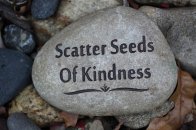
The importance of sowing seeds of kindness is found in a comment made by Leo Buscaglia: “Too often we underestimate the power of a touch, a smile, a kind word, a listening ear, an honest compliment, or the smallest act of caring, all of which have the potential to turn a life around.

Kindness is a form of communication that is not limited by ethnic or social barriers. It is a language that even the deaf can hear and the blind can see.

I encourage you to make a difference in the life of someone today—give them the gift of kindness. “Be the living expression of God’s kindness; kindness in your face, kindness in your eyes, kindness in your smile, kindness in your warm greeting.” ~Mother Teresa

The Power of a Good Book

readTwo of my childhood friends were Dick and Jane and their dog Spot.  From the moment I met them, I’ve had a love for reading.  Even when school recessed for the Summer, I rode my bicycle to the library two or three times a week to check out books.

An article in Quartz has identified a love for reading as the common trait that links the world’s most successful people.   According to the article, “Reading is the easiest way to continue the learning process, increase empathy, boost creativity, and even just unwind from a long day. But books can also change the way we think and live.”

Because he had experienced the transformational power of God’s Word, Paul emphasized its role in the life of the believer:

  • He instructed Timothy to, “give attention to the public reading of scripture, to exhortation, to teaching (I Timothy 4:13).”
  • He reminded the church at Rome that, “faith comes from hearing, and hearing through the word of Christ (Romans 10:17).”

Perhaps the one verse in the Bible that best defines its awesome power is Hebrews 4:12: “God means what he says. What he says goes. His powerful Word is sharp as a surgeon’s scalpel, cutting through everything, whether doubt or defense, laying us open to listen and obey. Nothing and no one is impervious to God’s Word. We can’t get away from it—no matter what.” ~The Message

I encourage you to consider your reading habits, and to use Psalm 119:14 as a prayer to guide you: “I will meditate on your precepts and fix my eyes on your ways. I will delight in your statutes; I will not forget your word. Open my eyes, that I may behold wondrous things out of your law.”