Be Purposeful in Your Random Acts of Kindness

The purpose of a newspaper headline is to capture your attention, so you will read the article.  The same is true with the bold heading on the pages of the internet.  They scream of a horrible crime, announce a recent tragedy, and some of them announce a random act of kindness.

I like random acts of kindness, and I’ve included a few that I found this morning:

  • A waitress at the Route 6 Café was stunned to find a diner had left a $1,000 tip for a $15.61 meal.
  • Whenever golfer Phil Mickelson sees kids selling lemonade stand, he buys a cup with a $100 bill and walks away.
  • Tamba Hali of the Kansas City Chiefs recently left a $1,000 tip at a steakhouse
  • After Bubba Watson won the Masters in April, he left a $148 tip at a Waffle House.

You might say, “Those are people who are wealthy and they can afford to do that.”  True, but they were not required to do it.

A few days prior to Christmas, I was given some money with the instructions:  “Use it however you can to help whoever needs it.”  I purchased 10 hams and several gifts cards and gave them in acts of random kindness to people I met.

To many of these people, the ham meant they would have a good meal for Christmas.  The gift cards, at least for a moment, removed the wrinkles that the framed the faces of people stressed by the worries of life.  Every one of the people who received the gift expressed their gratitude for this kind act made possible by the person who funded the effort.

One lady wrote a letter that said:  “I would like to think the man from your church who gave me and my children the gift card.  It was a wonderful act of kindness and great lesson for my children.”

When she was a child, Traci Bild and her brother scrounged up some spare change and decided to buy a Christmas Tree.  They showed the salesman their handful of change in their tiny palms, and he said:  “I think I have the perfect tree for you.” He walked away and came back with the largest tree on the lot.”

The Huffington Post printed a recent article of Bild’s as she retells this story to her children:  “Not too long ago I took my kids to Urbana, where I grew up. Driving past the cemetery we decided to pull in. “I want to show you something,” I said. I pulled up to what is now Jugs gravesite and tears fell from my eyes as I saw his name inscribed in stone. I told my kids about his amazing generosity to me both when I was a child of seven in search of that tree and later again in life as a teen of 15 in search of a job (he hired me to work at the Dairy Queen). This man, no longer alive will forever be present in my heart- his single random act of kindness played out in my mind over a lifetime. He probably had no idea what kind of impact he made on my life and that is what makes this story so special. He gave from the kindness of his heart, when no one was looking, because he could. What about you — can you do something unexpected for someone today?”

The kind acts of Jugs were moments that helped to jog the mind of Traci Bild, and set her on the right path in life.  What kind deed will you do?

Paul never used the phrase, random act of kindness, but he encouraged you to behave in such a way:  “Be kindly affectionate to one another with brotherly love, in honor giving preference to one another; 11 not lagging in diligence, fervent in spirit, serving the Lord; rejoicing in hope, patient in tribulation, continuing steadfastly in prayer; distributing to the needs of the saints, given to hospitality (Romans 12:10-13).”

B

The Memory Book of Life

If you use Facebook, you have probably seen the offer to tell your life story through photos you’ve posted during 2014.  The social media giant has bruised shins due to people kicking-back because the program has caused them to relive unwanted memories.

Facebook’s memory-making-methods pale in comparison to the life-in-review process that God has designed for each of us.  Let me shatter any feel-good, party-time thoughts with three words: the judgment seat.

The thoughts of the most stalwart among the faithful turn sober when they think of standing before the Righteous Judge, and He reviews each moment of our lives.  Think I’m kidding?  Here’s the proof:

  • Hebrews 9:27: It is appointed for men to die once, but after this the judgment.
  • 2 Corinthians 5:10: We must all appear before the judgment seat of Christ, that each one may receive the things done in the body, according to what he has done, whether good or bad.
  • Romans 14:10: We shall all stand before the judgment seat of Christ.

The good news is that God is not just a God of judgment, but He also a God of mercy and grace:  “. . .all of us also formerly lived out our lives in the cravings of our flesh, indulging the desires of the flesh and the mind, and were by nature children of wrath even as the rest…But God, being rich in mercy, because of his great love with which he loved us, even though we were dead in transgressions, made us alive together with Christ—by grace you are saved!

Since you know what the future holds, why not get a grip on the present.  Live 2015 with the resolve of the Apostle Paul:  “For me, living is Christ and dying is gain.”

What is the Cost of Satisfaction?

images (2)A recent article by Bourree Lam was posted to the Atlantic Journal.  Lam’s article focused on the economics of buffets and asked the question:  “If it costs more, does it taste better?”

To find the answer to the question, three researchers studied 139 diners at an all you can eat (AYCE) buffet:

  • Location of the experiment: Italian AYCE buffet in New York
  • Time Period: Two weeks
  • Criteria: Some of the139 participants were given a flier for an $8 buffet or a $4 buffet with both buffets serving the same food.
  • Results: People who ate from the $8 buffet rated the pizza 11% tastier than those who ate from the $4 buffet.

One of the authors of the study, David Just, said:  “People set their expectation of taste partially based on the price—and it becomes a self-fulfilling prophecy. If I didn’t pay much it can’t be that good. Moreover, each slice is worse than the last. People really ended up regretting choosing the buffet when it was cheap.”

After reading this article, I wondered about the value of “cheap” faith compared to costly faith:

  • Are Christians more satisfied, fulfilled, and happy, when their faith costs them something?
  • Is this one reason Solomon wrote, “Whatever your hand finds to do, do it with your might.”
  • Is this the secret to the saints of Hebrews 11 who lived vigorous faith-filled lives?

As you prepare to say good-bye to 2014, and enter 2015, let me suggest a New Year’s Resolution:  “I resolve to invest more in my life as a Christian, and I will do this by spending more time in prayer, reading my bible, and sharing my faith.”

Communication: Do You WiFi or Wee-Fee?

3-golden-rules-for-team-communicationDo you pay a Wee-Fee for your WiFi, or do you hee-hee when some people say Wee-Fee?  Most people reading this blog know that WiFi  is the wireless networking technology that uses radio waves to provide wireless high-speed connection to the internet.

What you may not know is that about 7% of the people living in Arkansas pronounce WiFi as Wee-Fee; however, they are not alone.  In fact, there are several countries that have a significant number of people who opt for the Wee-Fee pronunciation of the word:

  • Spain 49.3%
  • France 46.1%
  • Hungary 41%
  • Belgium 34.4%
  • Netherlands 33.7%

The meaning of WiFi does not change if it is pronounced Wee-Fee, but in some situations a mispronounced word can lead to heated circumstances.

I clearly remember an unclearly spoken word that created a state of confusion.  I was 18, and was asleep on the top floor of an old Air Force barracks when a backwoods sergeant ran down the hall shouting, “Far! Far!”  I thought:  “Far?  How far am I supposed to go and in which direction?”

“Far” took on new meaning and significance when the smell of burning wood began to find its way into my room.  I realized the sergeant with the hick-accent had not been shouting “far,” but was yelling “FIRE!”

One of the basic rules of communication is found in the acronym KISS (Keep It Simple Stupid).  The Apostle Paul could be profoundly simple in the way he stated truth, and he kept it simple and clear in Romans 6:23:  “The wages of sin is death, but the gift of God is eternal life through Jesus Christ our Lord.”

The wages of your sin cost God more than just a wee-fee, it cost Him the death of His son on the cross of Calvary.

Your WiFi might be what directs you to the internet, but it’s Jesus who connects you to Heaven.  Jesus said:  “I am the way the truth and the life no one comes to the Father except through me.”


Holiness and the Grace of God

isa6-holiness-e1361342892229The subject that seems to be the focal point of many Christian authors is grace.  Walk down the aisles of Barnes and Noble and look at the titles on the book shelves, and what do you see?  They are lined with rows of books that outline and discuss the subject of grace.

Evidently, grace sells.  But at what expense?  Does this emphasis on grace debase our perception of the Holiness of God?  If we give too much attention to the grace of God, do we lessen our comprehension of His holiness?

Notice the admonition of the Psalmist, and his focus on the holiness of God:

  • Psalm 29:2: Give unto the Lord the glory due to His name; Worship the Lord in the beauty of holiness.
  • Psalm 96:9: Worship the Lord in the beauty of holiness! Tremble before Him, all the earth.

Read the sixth chapter of Isaiah, and you will have a better understanding of the power of God’s holiness.  When Isaiah witnessed the glory of God, he saw the sinfulness of man—and he repented.

You diminish the beauty of His holiness and you cheapen His grace when you fail to give appropriate attention to your sin.  Grace is God’s righteous response to the unrighteousness of man.  To fully appreciate His grace, you cannot depreciate the magnitude of your sin.

When Paul wrote his first letter to Timothy, he gave a balanced assessment of grace and sin:

I thank Christ Jesus our Lord who has enabled me, because He counted me faithful, putting me into the ministry, although I was formerly a blasphemer, a persecutor, and an insolent man; but I obtained mercy because I did it ignorantly in unbelief.  And the grace of our Lord was exceedingly abundant, with faith and love which are in Christ Jesus.  This is a faithful saying and worthy of all acceptance, that Christ Jesus came into the world to save sinners, of whom I am chief.

When you get to the place to where you can recognize the prevalence and power of sin, you are at at the point where you will begin to recognize this this truth:  “. . . the grace of our Lord is exceedingly abundant, with faith and love which are in Christ Jesus.”

The Characteristics of Contentment

contentment1While watching the Kansas Jayhawks play basketball on Saturday, I became keenly aware of the intent and goal of each of the commercials on TV.  They were designed to arouse a sense of dissatisfaction and an incensed desire.

The pitch lines may have been a little different, but the message was the same:

  • You can’t be happy and fulfilled with the life you have—unless you buy our product.
  • You will never be whole and feel like you belong—unless you join our group or support our cause.

The more you believe the lies of the world, the more you will feel like somebody owes you some- thing. This breeds a sense of entitlement that can be the onset of resentment, and resentment and contentment cannot coexist.

This constant onslaught of “something must be bought” to find happiness and fulfillment or “the world owes you” is foreign to the thinking of the Apostle Paul:

Now godliness combined with contentment brings great profit.  For we have brought nothing into this world and so we cannot take a single thing out either.  But if we have food and shelter, we will be satisfied with that (I Timothy 6:6-8).

Notice the characteristics of contentment:

  • Godliness is enhanced by the presence of contentment
  • There is the realization that you were born with nothing and there is nothing in this world that you can take to heaven with you when you die
  • You are satisfied with the blessings God has given you and do not resent the manner in which He blesses others
  • The key to contentment is the content of your life, and Paul called this godliness

If want to hear the expression of contentment, take a moment to read Psalm 145.  In the first two verses of this Psalm you’ll find the words “praise” and “bless” repeated.  These are the words of contentment not resentment.

Here’s a thought to keep you thinking:   “Many people lose the small joys in the hope for the big happiness ( Pearl S. Buck).”

Eye-Opening Behavior

downloadWhy do you do what you do? Why do you work where you work? You may have never given much thought to these questions, but Paul knew the answers to them, and he testified of it in Acts 26: “I have appeared to you to appoint you as a servant and as a witness of what you have seen and will see of me. I will rescue you from your own people and from the Gentiles. I am sending you to them to open their eyes and turn them from darkness to light, and from the power of Satan to God, so that they may receive forgiveness of sins and a place among those who are sanctified by faith in me.”

Paul believed he had been commissioned to open eyes and to turn people from darkness to the light. It takes more than just talk to accomplish such a task. It also takes a consistent walk. This is why you are to, “Live your life in a manner worthy of the gospel of Christ (Philippians 1:27).”

Do you live an eye-opening life that turns people from darkness to the light? Do people look down on you or do they look up to you? This was a topic that Paul discussed with Timothy: “Don’t let people look down on you because you are young; see that they look up to you because you are an example to them in your speech and behavior, in your love and faith and sincerity (I Timothy 4:11-12).”

When you live a Christ-honoring, eye-opening life, you are an example in your speech, behavior, love, faith, and sincerity. I think this is part of what James had in mind when he said: “You have faith and I have works. Show me your faith without works and I will show you faith by my works (James 2:18).”

Is your faith an eye-opening example that points people to Jesus?

Ignition Contrition

A spilled salt shakerIn an act of public contrition General Motors has fired 15 employees and reprimanded 5 others following a cover-up regarding a faulty ignition switch. This glitch in technology has been linked to several accidents and deaths, and it has prompted an apology from GM’s Chief Executive, Mary Barra.

Ms. Barra described the behavior of GM as a “pattern of incompetence and neglect.” She also said: “We will accept responsibility for our mistakes, and we will do everything in our power to make sure this never happens again (WSJ Online).”

What is a pattern? It is the customary manner in which a business or organization operates or the behavior that defines a person.

In Paul’s letter to Titus he writes about a pattern or example that is to be followed. As you read it, notice what Paul says about a person’s individual responsibilities and the character traits he emphasizes: “Encourage younger men likewise to be self-controlled, showing yourself to be an example of good works in every way. In your teaching show integrity, dignity, and a sound message that cannot be criticized, so that any opponent will be at a loss, because he has nothing evil to say about us (Titus 2:6-8).”

Where is the self-control, integrity, and dignity today? They seem to have been replaced with crude conduct, a vocabulary of four letter words, and an anarchistic attitude.

In Colossians 5:6, Paul said, “Let your speech always be with grace, seasoned with salt (wisdom).” Is grace and salt (wisdom) a pattern of your life or have you forgotten the grace and become too salty in your speech?

The Habit of Excellence

Ever wonder why we keep doing the  things that we know we should not do and do not want to do?  I give you a little 5 letter answer to this encyclopedic problem–habit.

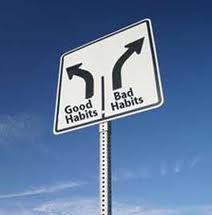
I believe it was Aristotle who said:  We are what we repeatedly do. Excellence, then, is not an act, but a habit.  Repetitious behavior is a coin with two sides:  good habits and bad habits. 

Because they are so ingrained in our lives, habits are often performed unconsciously.  This means we give little thought to some of the things we do.  This auto-pilot mentality is either a wonderful servant or a worrisome master. 

Research has shown that old habits appear to lose some of their power when new habits begin to replace them.  The new habit is a positive detour that bypasses the old rut.  

According to Ryan and Markova we form new habits by considering our three zones of existence: comfort, stretch and stress. Comfort is the realm of existing habit. Stress occurs when a challenge is so far beyond current experience as to be overwhelming. It’s that stretch zone in the middle — activities that feel a bit awkward and unfamiliar — where true change occurs.

Any time we try to kick a habit and develop a new skill, we can expect to experience some discomfort.  If you are right-handed, try writing or eating with your left hand.   Unless you are ambidextrous, it will feel a little odd or clumsy.

The same is true with any change in your routine.  At first it will seem awkward.  Several years ago I was told that I should substitute rice or almond milk for regular dairy milk.  The first time I tasted the substitute, my tastebuds shouted:  YUK!  I did a quick reframe of my response and said:  It isn’t milk, but it tastes pretty good for what it is.  And, I’ve done fine with it ever since.

New habits are not developed overnight.  At a minimum, I suggest 40 days of consistent practice as a start and for long-term success I think 3 months dedicated to the new routine is important.

Paul contrasted the habits of the flesh and the habits of the Spirit in Romans 6: I am using an example from everyday life because of your human limitations. Just as you used to offer yourselves as slaves to impurity and to ever-increasing wickedness, so now offer yourselves as slaves to righteousness leading to holiness.  When you were slaves to sin, you were free from the control of righteousness.  What benefit did you reap at that time from the things you are now ashamed of? Those things result in death!  But now that you have been set free from sin and have become slaves of God, the benefit you reap leads to holiness, and the result is eternal life.  For the wages of sin is death, but the gift of God is eternal life in Christ Jesus our Lord. 

I hope this thought keeps you thinking:  Where in your life do you need to intervene, so you can begin a healthy new routine?

Thoughtful or Thought-Filled?

I’m not sure that I’m a thoughtful person; however, I have no doubt that I am thought-filled.  My mind races from one thought to another at a speed, that even NASCAR can’t match.

If all these thoughts were positive and constructive, I’d be the envy of the world.  The trouble is that many of them are negative and destructive.

I’ve come to realize that either I control my thoughts or they control me.  Our thoughts are seeds that blossom into feelings and behaviors that make us either blooming idiots or citizens of substance.

Dick Tracy

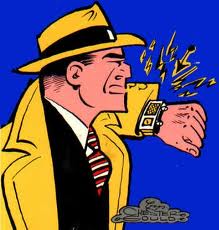
The increase in technology is directly connected to a decrease in thought-regulating quiet time.  Think with me for a moment about the rapid changes in society.  I can remember the Sunday edition of the paper and the watch-like apparatus Dick Tracy wore on his wrist.  Dick could be seen talking to a fellow detective with this device that was a pre-cursor to cell phones and video conferencing.  Most everyone thought this was far-fetched-thinking that would never happen in their lifetime, but we’ve gone from party-lines to cell phones with video capabilities in just a few short years.

And shortened years just might be the diagnosis, if we don’t learn how to slow down and still keep pace.  The question is:  How can we slow down, when the computer keeps us ramped up?

Here’s something I’m trying.  Every time I do a Google search, I pause just a second before I begin and say something positive and spiritual.  Prayers like this  have their roots in the words of the Apostle Paul:  Pray without ceasing (I Thess. 5:17); and in the thoughts of the old Quaker theologian, Rufus Jones:  Let a person’s inner being be fortified with a faith in God and all his creative powers are quickened, his marching strength is heightened and his grip on everyday things is immensely increased. It is as though he had tapped a hidden reservoir of power.

Let me share a few quick phrases that can be effective keyboard prayers:

·        Bless the Lord, my soul.

·        May Your will be accomplished in me.

·        Not my will, but yours.

·        Teach me. Guide me. Keep me

·        The Lord is the Rock of my salvation.

Instead of embracing the mentality of Atlas and trying to carry the weight of the world on my shoulders, I’m learning to use these mini-prayers as pace-setters as I walk with the Lord.

I think these words of Jesus from The Message provide a good summary of my thoughts:  Are you tired? Worn out? Burned out on religion? Come to me. Get away with me and you’ll recover your life. I’ll show you how to take a real rest. Walk with me and work with me—watch how I do it. Learn the unforced rhythms of grace. I won’t lay anything heavy or ill-fitting on you. Keep company with me and you’ll learn to live freely and lightly (Matthew 11:28-30).

I hope this thought keeps you thinking.