A Call to Action

LEODue to recent events and what I perceive to be a heightened level of danger directed toward people who wear the uniform, I encourage you to pray for both our military personnel and Law Enforcement Officers (LEO).

Many faith communities will recognize and pray for the military on Sunday, November 9th to honor veterans in advance of Veteran’s Day (November 11th).

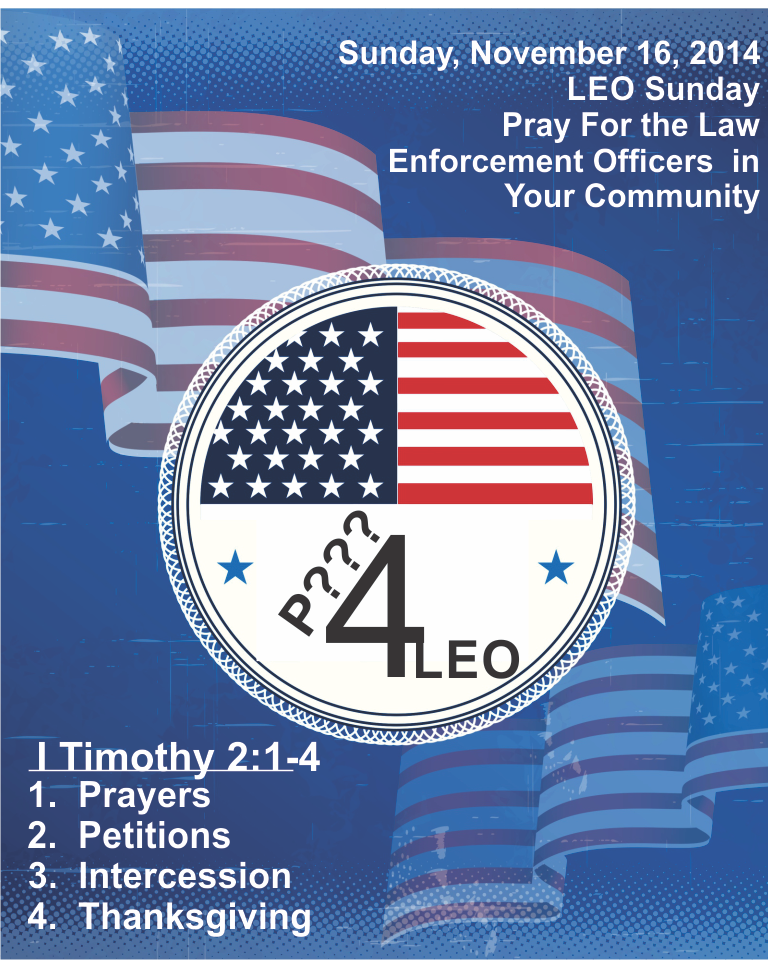
I ask you to join me and designate Sunday, November 16th as Pray 4 LEO Sunday. Feel free to copy the graphic on this page.

The theme verse I’ll use is I Timothy 2:1-4: “I urge, then, first of all, that petitions, prayers, intercession and thanksgiving be made for all people— for kings and all those in authority, that we may live peaceful and quiet lives in all godliness and holiness. This is good, and pleases God our Savior, who wants all people to be saved and to come to a knowledge of the truth.”

Please pass this on to pastors you know, your church, and through your email and social media (Facebook, etc.).

“. . . that we my live peaceful and quiet lives in all godliness and holiness . . .” and for the safety of those who protect us.


Baseball, Peanuts, and Superstitions

Take-Me-Out-to-the-Ball-Game-logo-FINAL-285x300During the Royals and Giants game on Wednesday night, I started eating roasted peanuts that were salted in the shell. When the 5th inning came to an end, I went to the cupboard, grabbed the peanuts, a soda, and returned to my chair. I popped the first peanut in my mouth and almost immediately the pop returned to the Royals’ bats.

If I was truly superstitious, I would eat from this same bag of peanuts for the remainder of the World Series. Baseball is a sport that is noted for its superstitions. Wade Boggs was one of the more superstitious players:

• He had to eat fried chicken before every game.
• On the nights he was in the lineup, he had to take batting practice at exactly 5:17.
• When he warmed up for a game, he would field 150 groundballs—not 149 or 151.
• Before he stepped into the batter’s box, he’d write CHAI (Hebrew for LIFE), in the dirt.

The superstitions of people have been a matter of discussion for thousands of years. Even the Apostle Paul addressed the issue with the philosophers on Mars Hill (Acts 17:22-24): “Men of Athens, I perceive that in all things you are very religious.”

The word “religious” is a Greek word (deisidaimonesteros) that means superstitious. The problem with the “men of Athens” was not that they worshipped too little, but they worshipped too much. These people had an altar for every god they could think of, and they even had one to “The Unknown God.”

In Paul’s letter to the church at Rome, he said the conundrum is not that God cannot be known, but that people choose to not acknowledge Him:

“God’s anger is revealed from heaven against every ungodly and immoral thing people do as they try to suppress the truth by their immoral living. What can be known about God is clear to them because he has made it clear to them. From the creation of the world, God’s invisible qualities, his eternal power and divine nature, have been clearly observed in what he made. As a result, people have no excuse. They knew God but did not praise and thank him for being God. Instead, their thoughts were pointless, and their misguided minds were plunged into darkness. While claiming to be wise, they became fools. They exchanged the glory of the immortal God for statues that looked like mortal humans, birds, animals, and snakes (Romans 1:18-22).”

How do you acknowledge God in your life?

Essential Communication

scrabbleI would imagine that most everyone who reads this blog has a cell phone. Not so long ago, the cell phone was thought of as a convenience, but it’s now considered to be an essential device for daily communication.

In a sense, the same can be said for prayer. Some people think of it as a convenience, while others recognize its true importance. It is the essential means through which we communicate with God.

The importance of prayer is seen in the words of Philip Yancey: “If prayer stands as the place where God and human beings meet, then I must learn about prayer. Most of my struggles in the Christian life circle around the same two themes: why God doesn’t act the way we want God to, and why I don’t act the way God wants me to. Prayer is the precise point where those themes converge.”

Several years ago I began to use the word PRAY as an acronym to guide my quiet moments with God:

Praise: Sing praises to God, sing praises; Sing praises to our King, sing praises. For God is King of all the earth (Psalm 47:5-7)

Repent: Search me, O God, and know my heart; Try me and know my anxious thoughts; and see if there be any hurtful way in me, and lead me in the everlasting way (Psalm 139:23-24).

Ask: Be anxious for nothing, but in everything by prayer and supplication with thanksgiving let your requests be made known to God. And the peace of God, which surpasses all comprehension, will guard your hearts and your minds in Christ Jesus (Philippians 4:6-7).

Yield: Trust in the Lord with all your heart and do not lean on your own understanding. In all your ways acknowledge Him, and He will make your paths straight (Proverbs 3:5-6).

As Yancey said, “If prayer stands as the place where God and human beings meet then I must learn about prayer.” I hope this PRAY acronym will help you learn more about prayer, and help you spend more time using this essential means of communication.

A Life of Purpose

life-purposeA recent Gallup poll surveyed the happiness levels of Americans and has found that the levels are at a four-year high. Almost 60 percent of Americans say they feel happy, and they do not have a lot of stress or worry.

The Center for Disease Control looked at another aspect of life and found that about 40% of Americans haven’t discovered a satisfying life purpose, and almost 25% of Americans report they do not have a strong sense of what makes their lives meaningful.

The quest for happiness and the search for meaning have different results. Researchers agree that when a person engages in a single-minded quest for happiness he discovers a pot of dissatisfaction at the end of his rainbow.

This was the sad case of the prodigal son. Victor Frankl showed an understanding of this paradox when he said: “It is the very pursuit of happiness that thwarts happiness.”

Frankl’s understanding of meaning, life’s purpose, and happiness was formed under the harsh conditions of a Nazi concentration camp. Frankl wrote of his experience in the 1946 best seller Man’s Search for Meaning. He had come to the conclusion that the difference between those who had lived and those who had died came down to one thing—meaning. His fellow prisoners who had found meaning in the dire conditions of the death camp were much more resilient than those who had not.

Frankl’s conclusions have been supported by research that shows the value of having purpose and meaning in life:

• It increases overall well-being and life satisfaction
• It improves mental and physical health
• It enhances resiliency, and self-esteem, and it decreases the chances of depression.

The Journal of Positive Psychology reported on research by Jennifer Aaker of Stanford Graduate School of Business. Aaker and her colleagues, found that “Happiness was linked to being a taker rather than a giver, whereas meaningfulness went with being a giver rather than a taker.”

The Apostle Paul knew a little something about givers and takers: “In all things I have shown you that by working hard in this way we must help the weak and remember the words of the Lord Jesus, how he himself said, ‘It is more blessed to give than to receive.’”

How about you? Are you a giver or a taker? When you find the answer to this question, you may find your purpose in life.

9 in 1

9in1175x175Gal. 5:22-23 says, “The fruit of the Spirit is love, joy, peace, patience, kindness, goodness, faithfulness, gentleness, self-control; against such things there is no law.”

When you read the verse above, did it register as plural or singular? When you read the phrase “fruit of the Spirit, did you think of more than one when you read the list that followed?

The Greek word for “fruit” is “karpos,” and it is in the singular. Even though there is a list of 9 graces, they are a unit of 1; and, they are already yours through the presence of the Spirit of God.

According to 1 John 4:8 and John 14:23, God is love, and His love is present within His children. With this in mind, think of this analogy: Love is the tree and these 9 graces are the fruit that it produces.

This may be what Paul had in mind when he said:

“It is God who is at work in you, both to will and to work for His good pleasure.” The fruit of the Spirit is the result of God’s divine power at work in you, and the words of Peter support my statement: “May grace and peace be yours in abundance through full knowledge of God and of Jesus our Lord! His divine power has given us everything we need for life and godliness through the full knowledge of the one who called us by His own glory and excellence. Through these He has given us His precious and wonderful promises, so that through them you may participate in the divine nature, seeing that you have escaped the corruption that is in the world caused by evil desires (2 Peter 1:2-4).”

When you put the words of Peter under a microscope, you can see:

• God’s grace and peace is available to you—in abundance!
• Everything you need for life and godliness is already at work in you and is accomplished not by your strength but by His divine power.
• God does not make mistakes, and He has called you by His own glory and excellence.
• God has given you the gift of His precious and wonderful promises—claim them!

9 in 1: love, joy, peace, patience, kindness, goodness, faithfulness, gentleness, self-control; these are the fruit of the Spirit. Is this fruit seen in you?

Do You Have The Look?

look“Teacher, which is the greatest commandment in the Law?” Jesus replied: “‘Love the Lord your God with all your heart and with all your soul and with all your mind.’ This is the first and greatest commandment. And the second is like it: ‘Love your neighbor as yourself.’ All the Law and the Prophets hang on these two commandments.”
—Matthew 22:36-40

Since Jesus emphasized the principles in this passage of Scripture I encourage you to do several things:
• Read it each morning this week before you leave your house and each evening before you go to bed.
• Ask God to give you a clear understanding of the meaning of these verses.
• Think about how this passage can help guide you in the context of three actions:
1. LOOK UP to God in worship God. This act deepens your personal relationship with Jesus Christ as you meet daily with God during times of private devotions.
2. LOOK IN to integrate biblical principles into your everyday life.
3. LOOK OUT to embrace the hurting people of your community. Invest a portion of your time, effort, and resources in your friends, family, neighbors and co-workers so they will comprehend what it means to be a Christian.

When you commit yourself to doing this, you will have the look of someone who loves the Lord with all of his heart, soul, and mind.

The Book of Boo

pumpkin-carving-05-slOctober is associated with the Fall Season and the time of year called autumn. You may notice its appearance at bedtime when you add a blanket to your bed; cooler temperatures greet you of a morning; leaves begin to fall; and you move your short sleeved shirts to the back of the closet and start dressing a little warmer.

October is also the trick or treat time of year. Children dress in costumes and practice their “boos” as part of the observance of Halloween.

I have some questions about the business of boo:

• If “boo” frightens a person are they scared twice as much if you shout “boo-boo!”
• If you were going to write a book about scaring people, would you call it a Boobook?

In the USA and other parts of the world, Boobook might be a good name for a book that is read around Halloween; however, in Australia it might not work due to a brown spotted owl from the land down under known as the Boobook.boobook

The Good Book is much different than what a Boo Book would be. The Bible is a book of comfort, and encouragement and the book of Psalms is proof of this:

• The Lord is my light and my salvation—whom should I fear? The Lord is the stronghold of my life—of whom should I be afraid (Ps. 27:1-2)?”
• “When I am afraid, I will trust in You. In God, whose word I praise, in God I trust; I will not fear. What can man do to me (Ps. 56:3-4)?”
• The one who lives under the protection of the Most High dwells in the shadow of the Almighty. I will say to the Lord, “My refuge and my fortress, my God, in whom I trust.”
He Himself will deliver you from the hunter’s net, from the destructive plague. Because you have made the Lord—my refuge, the Most High—your dwelling place, no harm will come to you; no plague will come near your tent. For He will give His angels orders concerning you, to protect you in all your ways (Ps. 91).”

Whether it is a season of the year or a specific situation in your life, the Bible offers promises to help you with the boo moments you encounter.

Do You Grok?

Nope! None of the words in the title of this post are misspelled. G-r-o-k is the correct spelling of this word that means to “communicate sympathetically.”

When Paul wrote his second letter to the church at Corinth, he addressed the issue of groking. The subject is of such importance he included “all the saints who are in the whole of Achaia (Greece) in the address line.

Notice Paul’s grokology: “Thank God, the Father of our Lord Jesus Christ, that he is our Father and the source of all mercy and comfort. For he gives us comfort in our trials so that we in turn may be able to give the same sort of strong sympathy to others in theirs. Indeed, experience shows that the more we share Christ’s suffering the more we are able to give of his encouragement. This means that if we experience trouble we can pass on to you comfort and spiritual help; for if we ourselves have been comforted we know how to encourage you to endure patiently the same sort of troubles that we have ourselves endured. We are quite confident that if you have to suffer troubles as we have done, then, like us, you will find the comfort and encouragement of God (2 Corinthians 1:3-7).”

Here are four principles from these verses:
• God is the true source of all mercy and comfort
• Whenever you are afflicted, you need His mercy and comfort
• Your experience of affliction, makes you suitable to encourage others in their affliction
• You do more than just share the experience, you share the comfort of Christ

To learn how to effectively grok, I encourage you to give some thought to these words of Paul: “Rejoice with those who rejoice, and weep with those who weep (Romans 12:15).”

Did I Just Lie?

I took two steps, then I asked myself: “Did I just lie?” While I was walking to my truck, I met a young man in the parking and asked: “How are you doing?” He replied: “Fine, how are you?” With a big smile, I replied” “Great!”

I took the two steps, and I thought to myself: “I’m sick at my stomach and I have a splitting headache, and I feel lousy, so am I great?”

It only took another second of reflection before my smile grew larger, and here’s why:
• I having a loving wife and a good family.
• I have a job, a roof over my head, and I have more than enough food to eat.
• I’ve never been exposed to Ebola or Malaria, and I don’t have cancer.
• I serve a loving God who has saved me through the sacrificial death of His Son.

I’m not great because of anything I’ve done or because of who I am; however, in comparison to much of the world, my circumstances are great.

***805 million people – or one in nine people in the world – do not have enough to eat.
***98% of the world’s undernourished people live in developing countries.
***66 million primary school-age children attend classes hungry across the developing world, with 23 million in Africa alone.
***Every 10 seconds, a child dies from hunger-related diseases.
***1.7 billion people lack access to clean water.
***2.3 billion people suffer from water-borne diseases each year.

“Young man, I’m great. Thanks for asking.”

Clueless or Less Clues

cloudPeople speak about “not having a clue” and “being clueless,” and they often have no idea about the origin of the word “clue.”

A quick look at Greek mythology will clue you in to the meaning of the word. When Theseus entered the Labyrinth to kill the, half-man, half-bull, Minotaur he unraveled a ball of string behind him, so he could find his way back. This ball of string was called a “clew.”

Sometime around the mid-1500s the spelling of “clew” was changed to clue and was used in reference to a fact or idea that could help solve a riddle, a task, or a problem

Since I don’t want you to be clueless about your relationship with Jesus let me share a clue or two with you:
• John 13:34-35 says that when we love as Jesus loved we are identified with Him.
• Find your way to John 14:6 and you will discover the clue to finding God.
• Read Matthew 7:7-8 and you will see the clue to prayer is in the acronym A.S.K.
• If you have a hunger that cannot be satisfied, the secret to a fulfilling diet is found in John 6:35.

Ravi Zacharias believes “true worship” is a clue to your relationship with God: “Man is by nature a religious entity. He finds objects or persons to worship and will ultimately reflect that object. It is for this reason that authentic worship is pivotal for the Christian’s life. True worship pulls together my conscience, heart, mind, imagination, and will. When these coalesce in unified expression, life finds its meaning.”

When your life is examined by your family and friends, and it will be, do they see a clue that points to Jesus, or do you leave them clueless? Alister McGrath has said that “Within each of us exists the image of God, however disfigured and corrupted by sin it may presently be. God is able to recover this image through grace as we are conformed to Christ.”

“the image of God in us”—a remarkable clue to everything I just said.