
Grace For The Moment

mercy-and-graceWhat picture comes to your mind when you think of Psalm 23? Is it a shepherd tending his flock? Do you have a vivid image of luscious green pastures where sheep are feeding? Perhaps your mind is fixed on the image of a stream of crystal clear water—water that quenches your thirst and refreshes your tired and weary body.

Whenever I read this Psalm, I think of three words that form a phrase that appears twice: “He leads me.” Shepherds are to lead sheep and sheep are to follow the shepherd.

When you follow the lead of the Good Shepherd, you will experience His grace for each moment of your life. This is an important truth—God does not give grace for the future. Just as the Israelites could not collect manna for a future day, but only the present, you cannot collect and hoard grace for a future need.

God’s grace is sufficient for your every need and for every breath of your life. This truth is proclaimed in Hebrews 4:16: “Let us therefore approach the throne of grace with fullest confidence, that we may receive mercy for our failures and grace to help in the hour of need.”

Here are the key points of the verse above:
• As one of God’s children, you have a family right of access to the throne of grace.
• It is the throne of GRACE, not philosophy.
• You can approach the throne of grace with confidence.
• You can have the expectation of receiving the mercy and grace you need for the moment.
• The mercy is designed to help with your “failures.”
• The grace is focused on providing “help.”
• All of this is for the exact moment you need it—“in the hour” of your need.

The key to all of this is found in the three words of Psalm 23: “He leads me.” When David followed the Good Shepherd he was blessed. When he strayed from the path of the Shepherd, he failed. In each case the mercy and grace of the Shepherd was present in his hour of need, and both are present for you as well.

What’s in a Name?

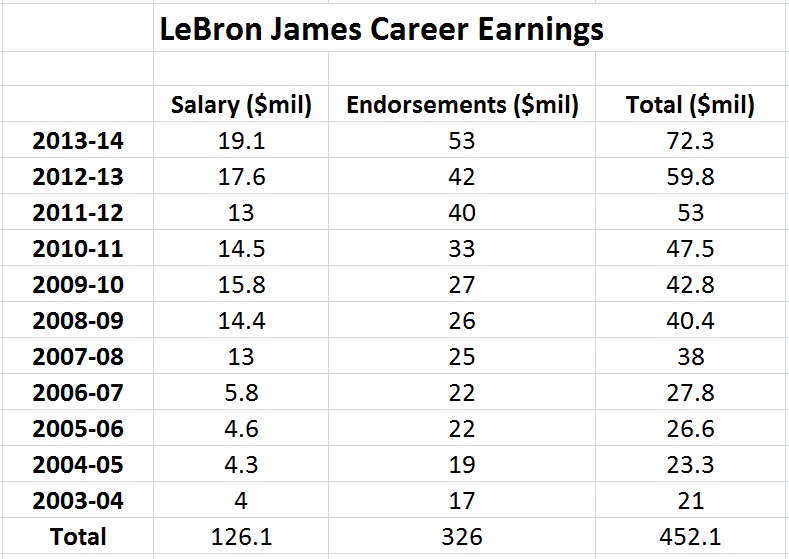
nameThe marketing power of today’s professional athlete never ceases to amaze me. I was listening to a report on either ESPN or CNBC that detailed the earnings power of LeBron James, and they are seen in the table below .

james

While there is a lot of dollar value to the name, “LeBron James,” there is still no comparison to power of Jesus name; and, Scripture testifies of this fact:
• Philippians 2:9-10: God has highly exalted him and bestowed on him the name that is above every name, 10 so that at the name of Jesus every knee should bow, in heaven and on earth and under the earth
• Acts 4:12 And there is salvation in no one else, for there is no other name under heaven given among men by which we must be saved
• Psalm 7:17 I will give to the Lord the thanks due to his righteousness, and I will sing praise to the name of the Lord, the Most High.
• Psalm 9:10 And those who know your name put their trust in you, for you, O Lord, have not forsaken those who seek you.
• Psalm 20:7 Some trust in chariots and some in horses, but we trust in the name of the Lord our God.
• Psalm 29:2 Give to the Lord the glory due his name; worship the Lord in the beauty of holiness.

Even though LeBron just inked a new deal with Nike that is incredibly lucrative, I still think the name of Jesus has more staying power, and His name is good for all eternity.

Take Time To Read The Fine Print

read-booksFrom the time I first learned to read, I’ve had a love for books, and an article I read in WSJ Online, reminded me of the importance and great benefit of reading.

The author, Jeanne Whalen, believes that reading just 30 minutes a day will:
• Improve your ability to concentrate
• Reduces your stress levels
• Deepen your ability to think, listen and empathize

Whalen isn’t alone in touting the benefits of reading:
• The Journal of Neurology cited a study of 300 elderly people that suggested regular engagement in mentally challenging activities, including reading, can slow the onset of memory loss.
• Developmental Psychology (1997) showed a correlation between a student’s first-grade reading ability and his 11th grade academic achievement

As I read this article, I thought of the promise and encouraging words that God spoke to Joshua (1:5-8): “No man shall be able to stand before you all the days of your life. Just as I was with Moses, so I will be with you. I will not leave you or forsake you. Be strong and courageous, for you shall cause this people to inherit the land that I swore to their fathers to give them. Only be strong and very courageous, being careful to do according to all the law that Moses my servant commanded you. Do not turn from it to the right hand or to the left, that you may have good success wherever you go. This Book of the Law shall not depart from your mouth, but you shall meditate on it day and night, so that you may be careful to do according to all that is written in it. For then you will make your way prosperous, and then you will have good success.”

Mark Twain once said: “The man who does not read has no advantage over the man who cannot read.” It is to your advantage to take time to read. I have often been blessed by reading a good book, and every time I read The Good Book, I am doubly blessed.

I conclude with a statement made by David Josiah Brewer (1837 –1910) who was an associate justice of the Supreme Court for 20 years: “No nation is better than its sacred book. In that book are expressed its highest ideals of life, and no nation rises above those ideals. No nation has a sacred book to be compared with ours. This American nation from its first settlement at Jamestown to the present hour is based upon and permeated by the principles of the Bible. The more this Bible enters into our national life the grander and purer and better will that life become”

A Five-Five Relationship

3-9-12-CMI-hands_of_god_and_adam-400-300x250One of my favorite sections of Scripture is Romans 5:1-5, and I read it again this morning. I call it the 5-5, and I share it with you below:

“Therefore, since we have been declared righteous by faith, we have peace with God through our Lord Jesus Christ. 2 We have also obtained access through Him by faith into this grace in which we stand, and we rejoice in the hope of the glory of God. 3 And not only that, but we also rejoice in our afflictions, because we know that affliction produces endurance, 4 endurance produces proven character, and proven character produces hope. 5 This hope will not disappoint us, because God’s love has been poured out in our hearts through the Holy Spirit who was given to us.”

In these brief verses, we find a long list of truths that provide the secret of our relationship with God through Jesus Christ:
• You are justified and declared righteous before God when you accept His son as your Savior.
• The initial result of your salvation is that you now have peace with God.
• As a child of God you have around-the-clock access to God—24/7.
• You can gain a better understanding of your affliction because hard times increase your endurance; the new found endurance builds character; and, Christ-like character produces hope.
• The hope within you is based on the love of God which has been “poured out” into your heart, and it is always available because the Holy Spirit now resides within you.

There is a reason I like to think of this section of Scripture as the 5-5. The 5-5 is a mnemonic that I use to help remind me of the relationship I have with God. SpeedLimitReduction55MPH Whenever I see a 55 MPH speed limit sign on the highway it reminds me of this Scripture and the peace I have with God through Jesus Christ.

The Maze of Monday Madness

mazeOnce the clock ticked past midnight last night, Sunday ended and Monday began. You had no say in the matter. Try as you might, there is no way that you can change the 24 hours of Sunday into 36 hours; and, you can’t skip Monday and jump ahead 24 hours into Tuesday.

You can, however, choose what kind of a Monday this will be. Will it be a Monday of madness or gladness?

To start the day off on the right foot, take a look at Psalms 18:24: “This is the day the Lord has made; let us rejoice and be glad in it.” Rejoice and be glad because God has blessed you with the gift of life and another day full opportunities.

To make the most of today, reflect on the words Paul shared with Timothy:

• Give thanks to Christ Jesus our Lord who gives you strength
• Praise Him because when you acted in ignorance and unbelief, He still blessed you with His mercy
• Think of the abundant resources of God: “the grace of our Lord overflowed, along with the faith and love that are in Christ Jesus”
• Remember why Jesus came into this world: “Christ Jesus came into the world to save sinners”
• Every time you stand up today, focus your thoughts on Paul’s benediction: “Now to the King eternal, immortal, invisible, the only God, be honor and glory forever and ever.”

If you’ve been lost in the Maze of Monday Madness, the formula above is the compass that will get you headed in the right direction.

Empty-Handed

handIn his lifetime, John D. Rockefeller was one of the wealthiest men alive. When he died, his accountant was asked: “Just how much did John D. leave?” The accountant wisely answered: “All of it.”

The words of Solomon confirm this truth: “As he came from his mother’s womb he shall go again, naked as he came, and shall take nothing for his toil that he may carry away in his hand (Ecclesiastes 5:15).”

This life’s goods will never make you good enough to get into heaven. This is a truth that Jesus shared with His disciples: “Be on your guard against covetousness in any shape or form. For a man’s real life in no way depends upon the number of his possessions (Luke 12:15).”

In light of this verse, ask yourself a couple of questions:
• Do my possessions possess me?
• Am I more focused on the here and now or on the there and then (heaven)?

You can stuff all the stuffing in the world into your Thanksgiving turkey, but he is still dead. Likewise, none of the stuff you’ve owned will be of any value to you once you are dead.

Now take a moment and read Ecclesiastes 5:15 again, and then compare it to what John says in the Revelation: “Blessed are the dead who die in the Lord . . . they may rest from their labors, for their deeds follow them!” It’s not the stuff of the world or your possessions that follow you—it is your deeds!

When you read Paul’s letter to the Corinthians, you can see that he has the “deeds” of life in mind: “The foundation is laid already, and no one can lay another, for it is Jesus Christ himself. But any man who builds on the foundation using as his material gold, silver, precious stones, wood, hay or stubble, must know that each man’s work will one day be shown for what it is. The day will show it plainly enough, for the day will arise in a blaze of fire, and that fire will prove the nature of each man’s work. If the work that the man has built upon the foundation will stand this test, he will be rewarded. But if a man’s work be destroyed under the test, he loses it all. He personally will be safe, though rather like a man rescued from a fire (I Corinthians 3).”

If your heart is full of the world, you will stand before Jesus empty handed. If, however, your heart is full of Jesus, you will stand the test and be rewarded (2 Timothy 4:7-8).

God Willing

god_willing_mug-r7056888776fc48d6ba16762a3baf25d2_x7jgr_8byvr_324Over the last couple of years, I’ve noticed something about my mail box. It has more junk mail and very few letters. The reason for this is the advent of email.

In the early history of our nation, travel was difficult and communication a challenge, so people were excited when they received a letter in the mail. In the early 1800’s a Christian might end his letter with a postscript consisting of two letters: D.V.

These letters stood for a Latin phrase, Deo Volente that means: “God willing.” This idea is expressed in the book of James: “If the Lord wills, we will live and do this or that (James 4:15).” The principle of this phrase and this verse is that we should not live a self-directed life.

A clear concept of Scripture is that we should seek the will of God. To do this you should:
• Be willing to embrace God’s will for your life (Isaiah 6:8).
• Look to God’s Word as a guide (Psalm 119:105).
• Seek Gods will through prayer (Jeremiah 33:3).

As you follow the steps above, you may notice that when you take God’s Word in, your praise for Him will go up; your faith will go out; and, God will strengthen you as you walk in His will.

Do You Do Your To Do?

NeglectWhen I examine the landscape of Christianity, I think our practical theology is so skewed that it’s more twisted than a Kansas twister. The focus of the church today seems to be more on a person’s bank account than on the salvation of no-account sinners.

Contrast this to Luke 4:18: “The Spirit of the Lord is upon me, because he has anointed me to proclaim good news to the poor. He has sent me to proclaim release to the captives and the regaining of sight to the blind, to set free those who are oppressed, to proclaim the year of the Lord’s favor.”

This To Do List of Jesus should be the lens through which we view the mission of the church, and the rhythmic cadence that calls us to march in step with His command to:
• Proclaim the good news of the gospel to the poor
• Proclaim freedom to the enslaved
• Open the eyes of the blind
• Open our arms to the oppressed

Which of the items above is on your To Do List? How do you view the poor and needy? There has been a tendency throughout the history of the church to overlook the “least of these” instead of looking out for them.

This was the case in Acts 6: “Now in these days when the disciples were increasing in number, a complaint by the Hellenists arose against the Hebrews because their widows were being neglected in the daily distribution.”

“Neglect” and “daily” are the key words in the Scripture above. “Neglect” refers to a side by side comparison for the purpose of value, and “daily” refers to the frequency of the distribution.

What does your daily distribution consist of and who do you neglect? Are your prayers reserved for just your family and friends or do they include the poor, needy, and the misfits of society?

Are you so focused on getting more and achieving personal happiness that you forget the enslaved, the blind, and the oppressed? If so, you’ll find happiness fleeting and never discover true contentment.

The Apostle Paul said: “I have learned in whatever situation I am to be content. I know how to be brought low, and I know how to abound. In any and every circumstance, I have learned the secret of facing plenty and hunger, abundance and need. I can do all things through him who strengthens me (Philippians 4).”

Paul experienced many “have” and “have not” moments in his life, and he knew that to “have not” Christ was to not have contentment. From the moment he met Jesus, Paul focused his life on the To Do List of his Lord. It became his mission and goal, and it is the secret to living a life of contentment.

The Winds of Adversity

depressed-manSomething occurred to me the other day while at the lake—I was all alone. There was no other boat to be seen—I had the lake to myself. It’s a rare moment to be the only boater on the lake, but when the wind is howling and the lake is churning foam and white capped waves most people have enough sense to stay on land.

My experience on the lake reminds me of how I’ve felt when I struggled through some trial—all alone. I didn’t understand what was happening or why it was happening and I wondered: “God where are you?”

This brings to mind two godly men—Joseph and Paul. Both of these men probably had moments when they wondered about their circumstances. Joseph languished in prison because Pharaoh’s cupbearer forgot him and the promise he had made (Genesis 40:14, 23; 41:1). Paul spent two years in prison because he had rankled Felix.

Both Pharaoh and Felix thought they were having their way with these bothersome individuals, but they weren’t. They were being used an instruments in the plan of God: “No wisdom, no understanding, no counsel can avail against the Lord (Proverbs 21:30).

God uses moments like these to develop you, to build your character, and to mold you into His image and likeness.

When I was about 8 years old, a 10 year old boy had me pinned to the ground as he punched me. I felt a sense of relief when my dad appeared out of nowhere. I said: “Dad, get him off of me.” Dad surprised me when he said: “Son, if you’re going to fight, you’d better learn how to win.” Those were not the words I expected to hear, and I was even more surprised when the toes of his work boots turned into heels as he turned around and walked away.

Like bragging Peter, I think God will let us struggle at times for the purpose of strengthening us. In hindsight, I now know that is what Dad was doing for me. I also know that the times I have felt all alone, God was still at my side, by my side, and on my side; and, I’ve learned that “I can all things through Christ who strengthens me (Phil. 4:13).”

Tough Love or Pass the Rolaids

rolaidsDo you have a roll of Rolaids or a Tums or two lying around? If you do, you may want to get them ready. What you’re about to read is hard to chew, difficult to swallow, and tough to digest.

When tears stream from your eyes and the weight of grief is so heavy you feel like you’re suffocating, you want words of comfort—not tough love. Words of comfort may sound good, but sometimes they are just sugar-coated, feel-good truisms, that have little to offer.

Tough love is different. It isn’t as apt to cuddle; there may be a sharpness to it; and, it might even shock you. The sovereignty of God is a tough love explanation of how God works in your life, and James and Peter define it. Before Jesus called them as disciples and positioned them as Apostles, they enjoyed time together on the Sea of Galilee. They had a lot in common: Jesus called them to leave their fishing business at the same time, and both of them were part of the inner circle that also included John.

But, when you come to Acts 12, their lives take a nasty turn in direction: James is martyred, but Peter is spared. In spite of the truth of Jeremiah 29:11, this is a Rolaids moment extraordinaire: “For I know the plans that I have for you,’ declares the Lord, ‘plans for well-being, and not for calamity, in order to give you a future and a hope.”

How would you like to try and explain that to the wife of James? Peter’s wife might quote it, but James’ wife may not comprehend it.

Here’s the tough love take-a-Tums-or-two principle of theology: If you believe in the goodness of God when everything in your life is going great, you need to trust it when everything is going wrong. The darkness of evil does not extinguish the light of God’s goodness. God is sovereign in what you perceive to be good as well as in what you deem to be disastrous.

Even though aching hearts turn a deaf ear to Ecclesiastes 7:14-15, it is a tough love truth of Scripture: “When times are good, be joyful; when times are bad, consider this: God made the one as well as the other, so people won’t seek anything outside of his best. I have seen it all during my pointless life: both a righteous person who dies while he is righteous, and a wicked person who lives to an old age, while remaining wicked.”

When times of adversity interrupt your life, you can benefit by taking an eternal perspective on your predicament. This is what Joseph did when his guilt-filled brothers approached him, he said: “You meant evil against me; but God meant it for good, in order to bring it about as it is this day, to save many people alive (Genesis 50:22).”

Life is an on-going conflict between a righteous and holy God and sinful man, so the cycle of life might startle you, but it never surprises God. The truth that needs to guide you is that, “for those who love God, and those who are the called according to his purpose, all things are working together for good (Romans 8:28).”

Remember this the next time you each for a toll of Rolaids: His grace is sufficient for all your trials (2 Corinthians 12:9); His peace is present for your anxieties (Philippians 4:6-7); and, He is always present with the strength you need (Isaiah 41:10).