Fill It Up

As I wrote the title for this post, it occurred to me that the phrase, fill it up, might be a bit archaic.  Due to the fact that the once prominent full service gas station has dwindled to a few in number, not many people pull up to a gas pump and say:  Fill it up.

Getting filled-up was the daily goal of my family as we gathered around the dinner table each evening.  This was also a time of conversation between family members that would, at times, end with a curious conclusion.

One evening, word had reached Mom and Pop about an incident at school.  I was identified as the perpetrator and the crime was hurting the feelings of some (probably dumb) girl.  So the conversation developed around how you can hurt the feelings of another person and what should be done when you do.

My youngest brother, Jeff, was about seven at the time, and he proudly joined the discussion by saying, I have feelings too, see!  He opened his mouth to display his dental work and pointed to the fillings in his teeth.

Over the years, I’ve come to believe that a person’s feelings about self in particular and the world in general are closely connected to what fills that person’s life.  Issues such as this deal with the concept of reciprocity, and it can be understood in terms of guilt and entitlement.

Guilty people feel they have given too little or received too much.  On the other end of the spectrum, entitled people feel they have given too much or received too little.  The thinking of these people is skewed when it comes to their obligations to others and the obligations of others to them. 

Because the life of the guilty and the entitled are filled with misconceptions, their feelings are little more than deceptions.  With this in mind, let me share an old adage of mine:  You may not be what you think you are, but what you think, you are.

So, when it comes to life, we need to fill it up with the right things.    To accomplish this, a person can take a mental step in the right direction by thinking on the right things.

Feeling A Little Scroogie?

How have the holidays been going for you this year?  Have you been the dispenser of gratitude orgriping?  Truth is, some people would rather choke to-death than sing Joy To The World.  And, by golly, there is no way in the world they will allow themselves to have a Holly Jolly Christmas.

Think I’m mistaken? Think again.  According to arecent Consumer Reports telephone survey of 1,013 people:
·        68 % of people hate the crowds and long lines during the holidays
·        37% could do without the weight gain and getting into debt
·        28% said gift shopping made them feel likeScrooge
·        25% of people said traveling, seeing certain relatives and seasonal music were all things they dreaded
·        15 % of people told Consumer Reports that being nice was a holiday downer
If you identify with all the findings of this survey, I have a New Year’s resolution for you.  Repeat after me:  I will not be a Scrooge in 2012.
As we get closer to the new year, we can benefit from the words of the apostle Paul—forget the past and move forward.

The Words We Use

When Jennifer was about to graduate from high school, I took her to Pittsburg, Kansas to check out the college.  As the graduate assistant took us on a tour of the campus, she pointed to a building and said:  This is the building that houses our astrology department.  I suggested that she ask her supervisor about her choice of words and said it was most likely the astronomy department.  She remarked:  Oh, is there a difference?

Words that sound the same and look a bit similar, often have totally different meanings.  Think about cosemtologist and cosmology.  It can be said that both words deal with some aspect of beauty.  Both words have cosmos (an orderly or harmonious system) as a prefix.  Cosmetologist comes from a Greek word that means skilled in adornment.  Cosmology is a discipline of philosophy that focuses on the origin and general structure of the universe.

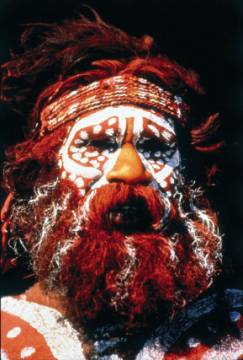
People use different words to express truth as they understand it.  When it comes to cosmology, the aborgine in the picture below will express his view of the world system in a different manner than would a scientist or a theologian.

Matt Slick explains the cosmological argument:

  1. Things exist.
  2. It is possible for those things to not exist.
  3. Whatever has the possibility of non existence, yet exists, has been caused to exist.
    1. Something cannot bring itself into existence, since it must exist to bring itself into existence, which is illogical.
  4. There cannot be an infinite number of causes to bring something into existence.
    1. An infinite regression of causes ultimately has no initial cause, which means there is no cause of existence.
    2. Since the universe exists, it must have a cause.
  5. Therefore, there must be an uncaused cause of all things.
  6. The uncaused cause must be God.

Thomas Aquinas (1224-1274) had a version of the Cosmological Argument called the Argument from Motion. He stated that things in motion could not have brought themselves into motion but must be caused to move. There cannot be an infinite regression of movers. Therefore, there must be an Unmoved Mover. This Unmoved Mover is God.

By the way, alot of time has passed since Jennifer was a high school senior.

When the Infinite Became an Infant

I went to SAMS today, and the noise of the hustling and bustling shoppers was almost deafening.  People were elbowing their way to the front of the samples booth where tasty strips of ham were being distributed and bite-size pieces of cheesecake were dished-out.

Most everyone in the store, including me, was on a mission.  Last minute purchases to fill a Christmas wish were the orders of the day for many.  For me, it was to get one of the taste-bud-tickling hams that were spiral cut and honey baked.  Yum!

The significance of these seasonal affairs will be lost, if the shopper’s sole focus is on the lastest fashion import instead of the heavenly export.  The prophet Isaiah spoke of this hundreds of years before the Messiah was ever born:  For unto us a child is born, unto us a son is given . . .  This prophecy foretold that day when the Infinite would become an infant. 

The apostle John could look back at the birth of Jesus with a God-inspired historical perspective and say, the Word was made flesh and dwelt among us . . .

After the gifts have all been opened, the Christmas music packed away, and the visiting family members have returned home, what remains?  It is the hope of Christmas that remains.  The knowledge that God has lived among us will encourage us in our darkest hours and strengthen us in our weakest moments.

Merry Christmas!