It’s Good, Delightful, and Desirable!

If something is described as being good, a delight, and desirable, what could possibly be wrong with it?

The problem with the alluring description above is that it has been removed from its context which follows: “When the woman saw that the tree was good for food, and that it was a delight to the eyes, and that the tree was to be desired to make one wise, she took of its fruit and ate, and she also gave some to her husband who was with her, and he ate. Then the eyes of both were opened . . .” And, this is the moment when death violated the human experience.

Eve’s fatal mistake occurred when she tuned God out and turned her attention to the Siren call of the Serpent. The song was both devious and deceptive and these are the shadowy veil of desire.

We need to be aware of the dark side of desire that can quickly ensnare us with greed or some other compulsive behavior; and, like the Serpent’s discussion with Eve, there is never a full disclosure of the fatal consequences of uncontrolled desire.

If the addict could see the end results of his drug use, would he have ever injected himself the first time? Would the alcoholic have taken the first drink?

The Apostle Paul warns us; don’t let anyone take you “captive by philosophy and empty deceit, according to human tradition, according to the elemental spirits of the world, and not according to Christ.”

When we feel the firm grip of desire, we need to quiet the static of the world and listen for the clear voice of God. David faced the power of desire at different times in his life. He discovered the key to success and wrote about in Psalm 119:9-11.

If you are struggling with some unwanted wants and some undesirable desires, let me make a simple suggestion: Set an alarm on your cell phone or computer that will ring at 9:11 each day for the next week. When it rings, read Psalm 119:9-11, and the principle of this verse will help give you the strength you need.

Think About It!
A Study in Contrasts

I was absent, but I was included. I know the story was more than just gossip because I’ve read the detailed first-person account of the incident.

One convicted criminal spent his last moments sneering, jeering, and cursing God. A few feet away another criminal realized the error of his way and was repentant. There was a third person who also had been deemed guilty, and his silence was a deafening echo.

Several soldiers were present and each one was dedicated to enforce the sentence that had been handed down. The dedication of these soldiers paled in comparison to the devotion of the heartbroken mother who watched their methodical execution of her son.

The day was full of contrasts. The scene was painted in bold brush strokes of black and white, unjust acts of cruelty and the faint colors of fairness; foreboding evil and enveloping goodness; and the certainty of death with the hope of life.

The climactic moment of that day occurred when the obscenity of wickedness met the hallowed and holy. In those seconds that seemed like hours, people witnessed the worst of humanity and the best of the Divinity.

This all happened on a particular day thousands of years ago. It was the day Jesus was hung on a cross. As He was suspended between heaven and earth, He became the essence of sin. On that day His earthly life was ended, so we could begin a new life with the gift of salvation. That was the day, He said, “It is finished”, so we could start over as a new creation in Christ (2 Corinthians 5:17).

That was the day that He gave the world the potential to change. Today is your day to make the most of the opportunity He has given to you.

Think about it!

It’s May 25th

To most people, May 25th is an insignificant day. It is just the 25th day of May, and there is nothing remarkable about it.

May 25th is much more to me. It is a day that kindles a fire in my brain and regenerates the memories and life-lessons that I formed in the first 12 years of my life.

My dad, Eddie Seymour, died in an oil field accident on May 25, 1965. I can remember the events of that day as clearly as if they were happening today. I can even tell you what I had in the brown paper sack that had my picnic lunch—a peanut butter and jelly sandwich and some corn chips.

Dad was 36 when he died. I was 12. That was 48 years ago, and the older I get the more I realize how young he was when he died; and, the older I get, the more I value the lessons I learned from him.

One memory that has been fresh on my mind today is a fishing trip when we were wading the Arkansas River down by Oxford. The river was running high and the current was so swift it washed the sandy bottom out from under my feet and it quickly carried me downstream. I can still hear Dad’s reassuring voice as he shouted out words of encouragement to me and guided me to the safety of the shore.

Whenever I think of that incident, I think of the times in my life when the currents of adversity have knocked me off my feet. In those times, I’ve heard the voice of my heavenly Father encouraging me: Come to Me, all of you who are weary and burdened, and I will give you rest. All of you, take up My yoke and learn from Me, because I am gentle and humble in heart, and you will find rest for yourselves. For My yoke is easy and My burden is light (Matthew 11).

Are you weary, worn out, and beat down from the trials of life? Listen carefully and you can hear that personal invitation: Come to Me.

What If?

The act of speculation has become an art form over the last week or so. Many well-grounded individuals have become instant speculators as they have given much time contemplating and considering a question: What if?

What if I win the lottery? This question is followed by comments about the muscle car that would be bought; the dream home that would be purchased; and, the exquisite once in a lifetime vacation that would be taken.

Let’s be honest, the odds of winning is just 1 in 175,223,510, so it is a mighty big what if. Still though, the imagination of people has run wild.

There are some things that are so absolutely wonderful they are beyond the comprehension of our weak and frail minds. Paul spoke of this in I Corinthians 2: No eye has seen, no ear has heard, and no mind has imagined the things that God has prepared for those who love him.

Regardless of how much energy and effort we exert, Paul says our imaginations find heaven to be unfathomable.

That last word in the sentence above comes from the word “fathom,” and it is defined as a unit of measurement that is equal to 6 feet. A fathom is used when a person is trying to ascertain the depth of water. When it comes to the subject of heaven, the depth and the wonders of glory land cannot be ascertained—only speculated about and imagined!

Whatever peace you can imagine, or joy, or love, or anything else you might think of, it isn’t even close to what it will really be like when we are in heaven with Jesus. Even the Apostle John said that heaven was more than he could imagine: We are God’s children now, and what we will be has not yet been revealed. We know that when He appears, we will be like Him . . .

I Can Only Imagine is a song by Mercy Me, and it ffers several thoughts worthy of your consideration, you can listen to it by clicking here.

Truthiness

Several years ago, comedian Stephen Colbert coined the term truthiness. This term sounds a bit like truthfulness; however, on a continuum, truthiness and truthfulness are at opposite ends.

The term truthiness is used when speaking of verifiable falsehoods that are repeated so often they seem to be true. Truthfulness is concerned with verifiable facts and the means of embracing and expressing them in an authenticate and genuine fashion

For something to be true, it must correspond to reality. If I were to say: The peel of a lemon is red, my statement would be false because it did not correspond with reality.

When it comes to the subject of truth, people will generally approach it from a relative or objective perspective. The results of a survey conducted by George Barna revealed the following:
• 63% of the American public believes there is no such thing as absolute truth
• Two people can define “truth” in conflicting ways and both would be correct
• 53% of adult church members believe there is no absolute truth

The sad truth is that far too many people are viewing life through the lens of relative truth. This is a perspective that asserts: What is true for me does not have to be true for you. Isn’t that like saying: If I believe 1+1 = 3, I am as correct as the person who believes 1 + 1 = 2?

Objective truth asserts that:
• Truth is true whether I believe it or not
• Truth is discovered or revealed, but it is not invented by a culture
• Truth is universal and trans-cultural

Personally, I believe objective truth is the fountain from which morals and ethics flow. Early in the history of our nation, the codified morals and ethical principles of the Ten Commandments influenced our founding fathers.

When a society rejects these principles and tries to function with human reasoning at the center and not God, the foundation begins to crumble. A case in point is the horrible atrocities committed by Dr. Kermit Gosnel. He rejected what we must hold dear—respect for life and human dignity.

When officials raided his clinic, they found amputated feet and other body parts of babies that he had mutilated, and this was after some had been born as living and viable human beings! Gosnel labeled the body parts of some of these babies and kept them in cold storage.

I believe the future holds something much different than cold storage for Gosnel.

Green Beanology

Like many of you, I worked outside this past weekend, and one of my tasks was my garden spot. As I planted my green beans, I remembered one of the supper table rules. My parents would say: “Eat a little bit every time and you’ll learn to like it.” Even though the rule was good in theory, Buster, my brother, never learned to like green beans. It was a sure bet that Buster would gag at the sight of a green bean on his plate.

Whenever I work in my garden, I’m reminded of certain words and phrases in the Bible; words like: sowing and reaping, grafting, pruning, and bearing fruit.

I wonder how these words apply to the Garden of Life and the opportunity to plant the seeds of kindness in the lives of others. To raise a good crop from these seeds, I should cultivate the garden with a smile; support it with a prayer; nurture it with acts of grace; and when necessary, mend it with mercy.

The prophet Jeremiah spoke of harvest time when he wrote: “The harvest is past, the summer is ended, and we are not saved!”

When harvest time comes, will your garden be barren or fruitful?

Think About It!
Stan

Citizen’s Arrest

No citizen should be at rest when far too many children cannot be at ease. When it comes to the subject of human trafficking, we ought to be self-appointed traffic cops.

Last Sunday I showed a video from love146.org to the people of First Christian Church. When the video ended, quite a few people who were wiping tears from their eyes.

We learned that human trafficking generates about $32 billion annually. It is incredibly hard for me to think of that as a profit when the loss column is framed with the images of innocent children—children victimized for the pleasure and sexual gratification of others.

Two children are sold into the commercial sex trade every minute of every day. That is 525,600 a year X 2 children, which is over 1 million a year. Not just one year, but year after year.

By the way, how old are you? How many precious lives have been ruined in your lifetime?

Even though President Lincoln issued the Emancipation Proclamation on January 1, 1863, and the 13th Amendment declared slavery to be illegal, it continues today.

We need to pray for those who are preyed upon, and we need to support the efforts of those who are fighting the fight to free those who are still in bondage.

If you are interested in getting involved, let me know.

Think About It!
Stan

238 Years Ago Today

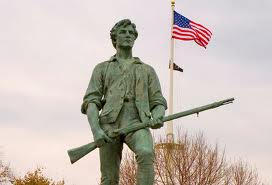
imagesDuring the early morning hours of April 19, 1775, 700 British Redcoats were on a mission to confiscate the firearms and ammunition of those who were considered a threat to the Crown of England. The morning air was thick with the anxiety and anticipation of the 77 colonial militia were waiting with muskets in hand. They were determined to defend their families, their freedoms and their town.

These men had responded to the call of Captain John Parker and the example of Pastor Jonas Clark. When the British were about a half a mile away, Captain Parker challenged Clark’s congregation and other MinuteMen, to stand as free men in Christ and fight: “Every man of you, who is equipped, follow me; and those of you who are not equipped, go into the meeting-house and furnish yourselves from the magazine, and immediately join the company.”

A British officer drew a line in the sand when he said: “Lay down your arms, ye damned rebels, or you are all dead men.”

Undeterred, Captain John Parker said: “Stand your ground! Don’t fire unless fired upon — but if they mean to have war, let it begin here.”

When this first battle at Lexington was over, 8 MinuteMen had paid the price of freedom as they died on the battlefield. A monument was erected to memorialize their sacrifice. The inscription reads: “On April 19, 1775, the die was cast!! The blood of the martyrs, in the cause of God and their country, was the cement of the Union of these states . . . they nobly dared to be free, and the peace, liberty and independence of the United States of America was their glorious reward!”

The actions of Pastor Clark and the members of his church were evidence of the sentiment and mindset of many of the colonial churches. Many pastors challenged their congregations to join the fight for freedom and even led them from the pulpit to the battlefield.

The patriotic fervor of 1775 is a stark contrast to the insipid response I see in the life of the church today. Too many freedoms are being consumed by the mammoth appetite of the current administration; its ever expanding government programs; its assault on our Second Amendment rights; and, what appears to be an utter disdain for the Christian worldview.

In this past week President Obama has prostituted the grief of the traumatized parents of Sandy Hook. He used Air Force One, at tax payers expense, to fly the parents to Washington and then parade them in and out of offices in an effort to restrict the Second Amendment.

When the President’s legislation was defeated, he angrily whined that it was the fault of a determined minority. The problem wasn’t the minority, it was the fact that the President could not twist enough arms to get a majority. This is the difference between a Republic and a Democracy, and the United States is a Republic.

I doubt I will ever own a BushMaster AR 15, but once you let the government in the hen house, the fox will rule the roost.

I think we have a sly fox who is ransacking too many hen houses.

A Fine Faith or A Faith fined

What did Jesus do when He died on the cross? The first answer that comes to a person’s mind is probably that He paid for our salvation. In his letter to the Colossians, Paul spoke of the death of Jesus this way: He erased the certificate of debt, with its obligations, that was against us and opposed to us, and has taken it out of the way by nailing it to the cross.

Even though Paul said the Law is dead, buried, and in the grave, people have kept trying to resurrect it. In the years both prior to and after the Revolutionary War, people were demanding strict adherence to Sabbath Laws.

In 1656, a Captain Kimble had returned from a 3 year stint at sea. When he met his wife on the doorstep of their house, he kissed her. Problem was, he kissed her in public and on the Sabbath Day, so he was placed in stocks for 2 hours.

In 1760 the Massachusetts legislature passed a law that fined any able-bodied person 10 shillings if said person was absent from public worship on the Lord’s Day.

One more example: In 1831, a woman was arrested for unnecessary travel on the Sabbath Day. She had violated the law by travelling to her father’s house on the Lord’s Day.

When we read the biblical record, we find that it was not the prostitutes and tax collectors who struggled with repentance, it was the people who were the most religious–the Pharisees.

When were are tempted to look down our long nose of religiosity, and judge others, we would do well to remember the words of Jesus in Matthew 7: “Don’t pick on people, jump on their failures, criticize their faults— unless, of course, you want the same treatment. That critical spirit has a way of boomeranging. It’s easy to see a smudge on your neighbor’s face and be oblivious to the ugly sneer on your own. Do you have the nerve to say, ‘Let me wash your face for you,’ when your own face is distorted by contempt? It’s this whole traveling road-show mentality all over again, playing a holier-than-thou part instead of just living your part. Wipe that ugly sneer off your own face, and you might be fit to offer a washcloth to your neighbor. –The Message

When we exhibit a spirit that is pious, self-righteous, and judgmental, we are trying to resurrect what Jesus buried. Jesus nailed the Law to the cross–leave it there!

The Lord is

I think I was in third grade when my teacher emphasized the importance of the letter “S” to me. I was trying to perfect my skill in cursive writing, and she reminded me that both my first and last names begin with the letter “S.” “Stan,” she said, “if your “S” cannot be read, no one will know who you are.”

In the title above, “s” is one of two letters that are of important. The other one is the letter “i,” and I don’t mean “I.” The capital “I” is a pronoun and usually the subject of a sentence.

The two letters I’m speaking of are of little significance when they stand alone. By themselves they are a little “i” and a measly “s.” Put them together, and they add up to something: i + s = is, and I like “is.”

“Is” is present tense: The Lord is . . . not has been, not maybe so, or hope so,or I wish so, but very boldly the Psalmist said: is!

John uses the same two letters when he writes in I John 4:16: “God is . . .” This was comforting to the collective group of believers who had faced the gruesome persecution of Nero and were about to suffer at the hands of Domitian.
When Paul wrote to the church at Rome, he emphasized the Is-ness of God while while facing the troubles and trials of life: Do you think anyone is going to be able to drive a wedge between us and Christ’s love for us? There is no way! Not trouble, not hard times, not hatred, not hunger, not homelessness, not bullying threats, not backstabbing, not even the worst sins listed in Scripture…None of this fazes us because Jesus loves us. I’m absolutely convinced that nothing—nothing living or dead, angelic or demonic, today or tomorrow, high or low, thinkable or unthinkable—absolutely nothing can get between us and God’s love because of the way that Jesus our Master has embraced us.

So, the next time you feel like you are going it alone, remember the Shepherd-Savior is present.