The Esau Syndrome

happy-treeWhile visiting with a neighbor, I was asked:  “Do you know anything about trees?” Before I could reply in the negative, he pointed to a tree that was losing its bark.  I suggested that he call an arborist or someone skilled in dendrochronology.

An arborist is someone who is trained to plant and cultivate trees, and dendrochronology studies tree rings to determine the dates and chronological order of past events.  By studying the rings of a tree, a person can identify the years that were dry spells and distinguish them from the wet seasons.

It’s not the rings of a person’s life that reveals his wet and dry seasons, but it’s the scars and the wrinkles.  Naomi is a woman who experienced both the wet and dry seasons.

As a young woman, she left Bethlehem with her husband and two sons.  Even though Moab was off-limits to Jews, she and her family settled there.  While living in the forbidden land of Moab, Naomi lost her husband, both sons, her wealth, and her beauty.

The dry years in Moab left their marks on Naomi.  By the time she returned to her homeland, her youthful skin had become wrinkled and she had been scarred by spiritual neglect.  When her old friends and neighbors saw her they asked:  “Is this Naomi?”

She replied:  “Don’t call me Naomi.  Call me Mara: for the Almighty has dealt very bitterly with me. I went out full, and the Lord has brought me home again empty.”

Because her life experiences had changed her, Naomi didn’t believe she was worthy of a name that means “pleasant, winsome, or agreeable.”   She believed the name Mara or “bitter” was more appropriate.

Naomi and her husband had made the same mistake that Esau made many years earlier.  Due to a lack of spiritual insight, he had traded his birthright to satisfy his short-term appetite:

“Work at getting along with each other and with God. Otherwise you’ll never get so much as a glimpse of God. Make sure no one gets left out of God’s generosity. Keep a sharp eye out for weeds of bitter discontent. A thistle or two gone to seed can ruin a whole garden in no time. Watch out for the Esau syndrome: trading away God’s lifelong gift in order to satisfy a short-term appetite. You well know how Esau later regretted that impulsive act and wanted God’s blessing—but by then it was too late, tears or no tears.”

What do the rings of your life say about you?  When you look into the mirror of God’s Word, what do you see?  Do you see the weeds of discontent or do you see the fruit of love, joy, and cheerfulness?
Siri: Where Am I?

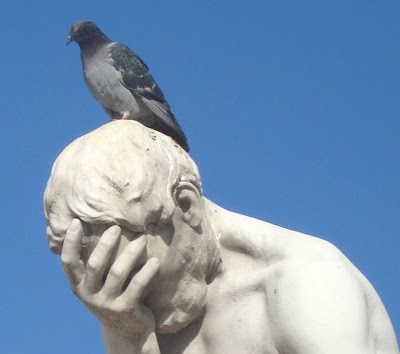
pigeon-statue-11If you were a statue, you would think of a pigeon about like the kennel boy does a dog.  Not me—I raised pigeons when I was just a kid, and the unique ability of these birds to find their way home has always amazed me.

Evidently Cornell and the University of Pittsburgh share my appreciation for this innate ability of pigeons.  The research from both universities has concluded that pigeons use multiple facilities to help them determine the correct sense of direction.  While the sun is their primary orientation, they also use the earth’s magnetic field as a guide to get them safely home.

After an all-to-common and failed attempt to get directions from Siri (iPhone), I’ve decided I might have better luck finding my way home if I could somehow tether my truck to a pigeon.  Even though I speak clearly, Siri only understands about 10% of what I say when I ask for directions.

As I thought about the proficiency of the pigeons and the sad service of Siri, I was reminded of the words of Jesus:  My sheep hear my voice and I know them and they follow me.

Whenever we are lost or feel alone, we can listen for the Shepherd’s voice and have the comfort of knowing we are never lost when we are with Him.

God-Colors

plan-your-visitDid you accept the challenge I proposed yesterday?  If you read this blog on Thursday, you know that I encouraged you to be the peace in your piece of the world.

If you embraced my challenge, you were living the words of Jesus found in Matthew 5:16:  “Let your light so shine before men, that they may see your good works and glorify your Father in heaven.”

The Message elaborates on this command of Jesus:

“You’re here to be light, bringing out the God-colors in the world. God is not a secret to be kept. We’re going public with this, as public as a city on a hill. If I make you light-bearers, you don’t think I’m going to hide you under a bucket, do you? I’m putting you on a light stand. Now that I’ve put you there on a hilltop, on a light stand—shine! Keep open house; be generous with your lives. By opening up to others, you’ll prompt people to open up with God, this generous Father in heaven (Matthew 5:14-16).”

If you made my goal your goal, and you did your best to be the peace in your piece of the world, you were cherishing a basic principle of Jesus.  You were, “bringing out the God-colors” in your piece of the world, and people had the chance to see your light shining. They could see your “good works” in:

  • Your warm smile they enjoyed awhile because it reflected the love of God.
  • Your courteous disposition that was void of suspicion and full of sincerity.
  • Your word that cheered them while others jeered them. You were the “you-can-do-it” voice they needed to hear.
  • Your hand that helped them stand: You reached down, to help them stand up.

If you missed my challenge on Thursday, you can accept it today.  Be a “light-bearer” for Jesus, so you can share the dazzling light of God-colors.

I would like to hear your comments:  What do you think of when you think of “God-colors?”

Your Piece of the World

03world-puzzleWhether you live in the USA, England, Europe, Africa, or Asia, there is one thing you hold in common.  You and the rest of humanity want peace in your piece of the world–certainly, this is the case in El Paso, Texas, and Dayton, Ohio this morning.

I know I’ve grown weary of all the protests, murders, shootings, and rapes that I see on the screen of my TV.  The headlines of the newspaper are depressing with stories of theft, scandals, and abused children.

Here is what I am going to do in my piece of the world today. Instead of being, “overcome by evil, I’m going to overcome evil with good (Romans 12:21).”  I am going to try my best to, “pursue the things which make for peace and the things by which one may edify another (Romans 14:19).”  J.B. Philipps translated this same verse in these words:  “Let us concentrate on the things which make for harmony, and on the growth of one another’s character.”

Will you join me and make this your goal for today:

  • I will pursue and concentrate on bringing peace to my piece of the world.
  • When confronted with the off-key and unkind remarks of others, I will try to bring harmony to the situation.
  • I will do my best to be a positive presence in the life of those I encounter.

So what in the world are you going to do today?  I encourage you to bring peace to your piece of the world.

The High Cost of Faith

google-analytics-demographicsThe closer a person gets to retiring, the more focused he is on making good investments.  All investment decisions are important–including those associated with faith and missions.

The findings of Gil Anger, concerning the work of Christian missionaries, shed some light on this question (Statistic Brain Research Institute):

  • There are 419,000 people who are classified as foreign missionaries.
  • There are 26 countries that do not allow missionaries.
  • 629 Billion people have never been evangelized.
  • $250,000,000 is spent annually on Christian foreign missionary work.

The four points above are focused on demographics and dollars.   Is this an accurate reflection on the high cost of faith?  I don’t think so.  To understand the value of sharing the faith, you need to think of more than just the cost of an arm and a leg—you need to consider the sacrifice of a life.

When he wrote to the church at Corinth, Paul reminded them: “You have been bought with a price: therefore glorify God in your body.”  The high cost of faith is seen in the immeasurable love of God for you.

When you begin to comprehend the full meaning of being “bought at a price,” I hope you will also grasp the fact that in return you are to “glorify God in your body.”    Paul may have had this in mind when he said:

My response is to get down on my knees before the Father, this magnificent Father who parcels out all heaven and earth. I ask him to strengthen you by his Spirit—not a brute strength but a glorious inner strength—that Christ will live in you as you open the door and invite him in. And I ask him that with both feet planted firmly on love, you’ll be able to take in with all followers of Jesus the extravagant dimensions of Christ’s love. Reach out and experience the breadth! Test its length! Plumb the depths! Rise to the heights! Live full lives, full in the fullness of God.God can do anything, you know—far more than you could ever imagine or guess or request in your wildest dreams! He does it not by pushing us around but by working within us, his Spirit deeply and gently within us.


Are You Eyesome or an Eyesore?

in_the_eyes_of_god_by_rainacornasusgirl-d652cziEyesome is a word that I had never seen or heard of until yesterday, and it means, “Pleasant to look at.” When I discovered its meaning, I thought of the words of Peter when he spoke of the “incorruptible beauty of a gentle and quiet spirit, which is very precious in the sight of God (I Peter 3:4).”

I see fewer eyesome people who are noted for their “incorruptible beauty” and “gentle and quiet spirits.” Instead, there seems to be a proliferation of people who proudly exhibit a spirit that is reckless and impetuous.  This sort of person is less eyesome and more of an eyesore with a spirit that is rude, crude and arrogant.

What can you learn when you focus your eye on some of the Scripture below?

  • In Ephesian 4:1-3, Paul said I “urge you to live in a way that is worthy of the calling to which you have been called, demonstrating all expressions of humility, gentleness, and patience, accepting one another in love. Do your best to maintain the unity of the Spirit by means of the bond of peace.
  • In his advice to young Timothy, Paul instructed him to “pursue righteousness, godliness, faith, love, patience, gentleness (I Timothy 6:11).”
  • Paul emphasized the importance of gentleness when he wrote to the church at Philippi: “Let your gentleness be known to all men (Philippians 4:5).”

To be perceived as more eyesome and less of an eyesore, I encourage you to give some thought to Psalm 90:17:  “Let the beauty of the Lord our God be upon us, and establish the work of our hands for us.”

The “beauty of the Lord” does not speak of any physical feature, but it does mean that God can make you an eyesome creature.  When His beauty is upon you, He will begin to develop the “incorruptible beauty of a gentle and quiet spirit, which is very precious” in His sight.

A Silhouette of Truth

61336241Like many other sports fans across the USA, my TV has been dominated by ESPN and college basketball. As I was watching to see where and when KU and WSU would play, I remembered a quote by John Wooden: “It’s what you learn after you know it all that counts.”

Wooden’s words remind me of the self-portrait Paul painted in Philippians:  “If it were right to have such confidence, I could certainly have it, and if any of these men thinks he has grounds for such confidence I can assure him I have more. I was born a true Jew, I was circumcised on the eighth day, I was a member of the tribe of Benjamin, I was in fact a full-blooded Jew. As far as keeping the Law is concerned I was a Pharisee, and you can judge my enthusiasm for the Jewish faith by my active persecution of the Church. As far as the Law’s righteousness is concerned, I don’t think anyone could have found fault with me (Philippians 3:4-6).”

As a Pharisee Paul thought he knew it all, but when he met Jesus he underwent a radical change:  “But everything that was a gain to me, I have considered to be a loss because of Christ. More than that, I also consider everything to be a loss in view of the surpassing value of knowing Christ Jesus my Lord. Because of Him I have suffered the loss of all things and consider them filth, so that I may gain Christ and be found in Him, not having a righteousness of my own from the law, but one that is through faith in Christ—the righteousness from God based on faith.  My goal is to know Him and the power of His resurrection and the fellowship of His sufferings, being conformed to His death, assuming that I will somehow reach the resurrection from among the dead (Philippians 3:7-11).”

Let me paraphrase the verses above in just a few words:  “I got rid of my worthless-self-righteous-know-it-all attitude, so I could know Jesus.”

Stephen Covey said that, “In the last analysis, what we are communicates far more eloquently than anything we say or do.”  The “what-we-are” communication of Paul, was the harsh restrictive, and punitive mindset of the Old Testament.  Paul knew the nitty-gritty essence of what it took to be a Pharisee, but he didn’t have an itty-bitty speck of “what-we-are” grace. Paul was a know-it-all theologian, and at his core, he would abhor the grace-themed principles of Christianity.

Paul’s pace was slowed on the Damascus Road, when he had a personal encounter with Jesus. Up to this point in his life, Paul had tried to find fullness in a silhouette of truth. When he met the Way, the Truth, and the Life, Paul couldn’t ignore His majestic mercy and the grace galore that Jesus offers.

The arrogance of what Paul was, was quickly overshadowed by the eloquence of what he became. He became a Christian of significance because he was not content to just talk-it-up.  He knew he needed to live-it-out.

The Covey quote I shared earlier seems to be based on the teaching of John: “Let us not love in word or talk but in deed and in truth.”  If “what we are” determines the effectiveness of what we say, how influential is your life?

A Joyful Heart

Beautiful smiling cute babyMy concept of God might be different than yours.  I believe God is loving, caring, and full of joy.  God gave us our sight so we can have the pleasure of seeing rainbows,  butterflies, and majestic mountain ranges.

I thank God that He blessed me with the sense of smell, so I can enjoy the aroma of a freshly baked cake; and I am overjoyed that He created me with taste buds, so I can savor the flavor of apple pie topped off with a big dip of vanilla ice cream.

On my journeys into the wilderness, I’ve enjoyed the solitude of silence that is only interrupted by the chirping of a bird, the whistle of a quail, or the refreshing sound of a flowing river.

I’m glad that God wants His people to experience the wonder of joy and the fruit of happiness.  Solomon wrote of this in the Proverbs: “A joyful heart makes a face cheerful, but a sad heart produces a broken spirit . . . a cheerful heart has a continual feast (15:13, 15).”

A couple of chapters later, Solomon draws a contrast between the joyless and the joy-filled:    “One with a twisted mind will not succeed, and one with deceitful speech will fall into ruin. A joyful heart is good medicine, but a broken spirit dries up the bones (17:20, 22).”

Since a joyful heart is good medicine, here’s a medicine chest full of quotes:

  • The art of being happy lies in the power of extracting happiness from common things. ~ Henry Ward Beecher
  • I think I began learning long ago that those who are happiest are those who do the most for others. ~ Booker T. Washington
  • If we try hard to bring happiness to others, we cannot stop it from coming to us also. To get joy, we must give it, and to keep joy, we must scatter it. ~John Templeton
  • You have loved righteousness and hated lawlessness; this is why God, Your God has anointed you with the oil of joy. ~Hebrews 1:9
  • I have spoken these things to you so that My joy may be in you and your joy may be complete. This is My command: Love one another as I have loved you. ~John 15:11-12

The key to living a life of joy is found in the words of the Psalmist:  “You reveal the path of life to me; in Your presence is abundant joy; in Your right hand are eternal pleasures.” ~Psalm 16:11

Three questions come to mind when I think of the verse above:

  • Since God reveals the path of life to you, why take a detour?
  • If abundant joy is found in His presence, what do you have when you refuse it?
  • If eternal pleasures are in God’s right hand, what is left? Temporary and unfulfilling worthless worries?

I’ll close with the words of Paul:  “Rejoice in the Lord always. I will say it again: Rejoice!” ~Philippians 4:4

The Meaning of LIfe

meaning-of-life-37When you first see the word, you may wonder if you will remember how to spell it.  When you try to read it, you may think you will mispronounce it.  The word is Ecclesiastes, and it is one of the Wisdom books of the Old Testament.

Ecclesiastes is a record of Solomon’s attempt to find the meaning of life.  When you get to the last chapter of the book, Solomon makes a summary statement:  “Now all has been heard; here is the conclusion of the matter: Fear God and keep his commandments, for this is the whole duty of man. For God will bring every deed into judgment, including every hidden thing, whether it is good or evil.”

There are some places in this book where you will find a phrase is repeated several times.  The fourth chapter is a good example:

  • 4:1: “the oppression that is done under the sun”
  • 4:3: “the evil work that is done under the sun”
  • 4:7: “I saw vanity under the sun”

The three repeated words, “under the sun,” reveal the key to Solomon’s frustration.  His attempt to find meaning in life was difficult.  “Under the sun” places the emphasis on a horizontal perspective at the expense of the vertical dimension.

What Solomon initially failed to grasp, was firmly gripped by Paul.  Notice how he accentuates the vertical perspective of the Christian life: “Seek those things which are above, where Christ is, sitting at the right hand of God.  Set your mind on things above, not on things on the earth  (Colossians 3).”

Paul’s use of the word “above” calls attention to the vertical perspective and contrasts it to the “things on earth,” or the horizontal realm.  Which one of these orientations guides you?

The answer to this question is found in what you wear:  What have you put off and what have you put on?

  • Paul said you should, “Put off all these: anger, wrath, malice, blasphemy, filthy language out of your mouth. Do not lie to one another, since you have put off the old man with his deeds.
  • Once you have put off the horizontal, you are ready to put on the vertical: “Put on the new man who is renewed in knowledge according to the image of Him who created you.”

There were times when I was a kid that I would frustrate my parents and they would ask:  “What in the world do you think you’re doing?”  That’s not a question you need to answer; however, you might think about this:  How are you living under the sun, and what have you put off and put on?

It’s The Time of Your Life

google-calendar_logoBeing on time and staying on schedule could be a difficult task for me, but it isn’t.  Google Calendar is an application I use every day to help me manage my life.

Each morning when I start my day, I have an email from Google waiting on me.  When I open it, I find my schedule for that day.  I don’t have to wander through the day wondering what I am supposed to do.  Thanks to Google, I already know.

The person who waits for the right time to do something fails to realize that time is a precious commodity that quickly rots when wasted and spoils the opportunity of the moment.  It doesn’t make any difference if you think you are living in the best of times or the worst of times, this is the only time you have—it is the time of your life.

You have 60 minutes in every hour; 1,440 of them every day; 10,080 of them every week; and a whole bunch of them in a year.  If you will manage the minutes of your life, the hours will take care of themselves.

The time of your life is so important, the psalmist said:  “Teach us to number each of our days, so that we may grow in wisdom (90:12).”  The idea is not that you assign a number to each day of your life.  The concept is that you get the most out of each day, so you are living it for the glory of God.

Carl Sandburg captured the essence of this discussion when he said:  “Time is the coin of your life. It is the only coin you have, and only you can determine how it will be spent. Be careful lest you let other people spend it for you.”

It is the time of your life, so spend it wisely.