
Fireflies At Night

fireflyPeople rarely partner stubbed toes and skinned knees with moments of pleasure . . . unless you’ve been a spunky kid who chased the sentinels of light through the darkness of July nights. Even though those carefree days of bare feet and childhood innocence are long gone, I still enjoy the nocturnal dance of fireflies as they flutter across the night sky.

The waltz of the firefly reminds me of an old quote by Beecher:

If I were made a firefly, it would not become me to say: “If God had only made me a star to shine always, then I would shine.” It is my duty, if I am a firefly, to fly and sparkle, and fly and sparkle; not to shut my wings down over my phosphorescent self because God did not make me a sun or a star.

Regardless of person’s station in life, there seems to be a pervasive sense of dissatisfaction.  Solomon commented on this in Proverbs 27:19-20:  Just as water reflects a person’s true face, so the human heart reflects a person’s true character. As Death and Destruction are never satisfied, so the eyes of a person are never satisfied.

From their teenage years forward, people engage in an unending search for that elusive person, place, or thing that will satisfy the desires of their heart. The trivial pursuits of this world’s pleasures will never provide lasting satisfaction; you simply cannot find fulfillment in empty promises

Lasting peace and satisfaction is not found in the creation, but in the Creator:

  • Jesus said: “I am the bread of life; whoever comes to me shall not hunger, and whoever believes in me shall never thirst.” (John 6:35)
  • God satisfies the longing soul, and the hungry soul is filled with good things. (Psalm 107:9)
  • Notice the promise of Psalm 16:11: God You reveal the path of life to me; in Your presence is abundant joy; in Your right hand are eternal pleasures.

The next time you see a firefly at night, pause and think about what it means to be content in and satisfied through Jesus.  When you do this, it might help to reflect on these words of Paul:

 I’m glad in God, far happier than you would ever guess—happy that you’re again showing such strong concern for me. Not that you ever quit praying and thinking about me. You just had no chance to show it. Actually, I don’t have a sense of needing anything personally. I’ve learned by now to be quite content whatever my circumstances. I’m just as happy with little as with much, with much as with little. I’ve found the recipe for being happy whether full or hungry, hands full or hands empty. Whatever I have, wherever I am, I can make it through anything in the One who makes me who I am. I don’t mean that your help didn’t mean a lot to me—it did. It was a beautiful thing that you came alongside me in my troubles. ~Philippians 4 (The Message)
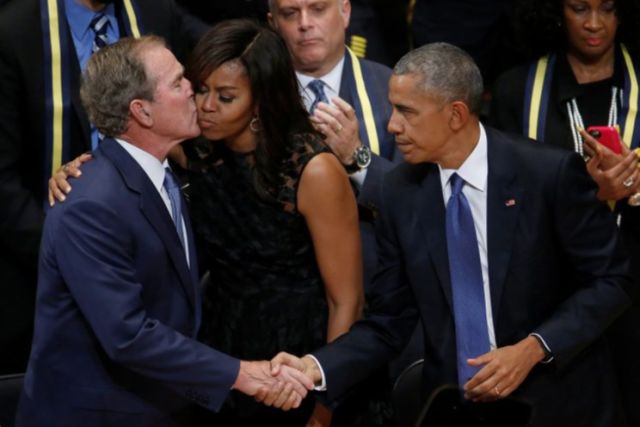
Let The Healing Begin

Help each other with your troubles. When you do this, you truly obey the law of Christ.  bush~Galatians 6:2 (International Children’s Bible)

Dumb Kid or Racist

IMG_0009I was just a dumb kid from Kansas when I enlisted in the Air Force in 1971. Like all new recruits, I was sent to Lackland Air Force base in San Antonio for boot camp.  This was the camp where all new recruits learned the Air Force way of doing things.

One of the requirements of boot camp was to have a spit polish on your boots that would reflect the ugly mug of the drill sergeant. During the first inspection my boots didn’t pass muster, and I suffered the consequences; I decided I had to do something before the next inspection.

Since the recruit next to me had polished his shoes to a high sheen and the drill sergeant had praised him, I offered to pay him if he would polish my boots. This dumb kid, a white boy from Kansas, never thought his request would be considered racist. I simply wanted to benefit from the skill of the person next to me, and I didn’t see him as a black man—just another guy trying to get through boot camp; but, he thought I was looking for a “boy” to shine the Master’s shoes.

Our difference in perspective, due to history, and culture, led to a flash of anger that had its roots in the riots of the late 60’s. The events of this past week rekindled the memory of that experience from 1971.

Was I a dumb kid from Kansas or a racist?  I can undoubtedly confirm that I was dumb, but just as certainly I can say there was no racism in my request.

It would be naive to think that racism did not exist then or that it does not exist today. Sadly, the hideous face of racism has been present since the early days of man’s history.

Paul spoke of the ethnic and racial divide between Jews and others when he wrote to the church at Ephesus.  He said Jesus “brought an end to the commandments and demands found in Moses’ Teachings so that he could take Jewish and non-Jewish people and create one new humanity in himself. So he made peace.  He also brought them back to God in one body by his cross, on which he killed the hostility.  He came with the Good News of peace for you who were far away and for those who were near.  So Jewish and non-Jewish people can go to the Father in one Spirit.~Ephesians 2:15-18 GW

After the multiple tragedies of last week, I think most of us are looking for healing.  If you only look to the past and the many failures of social engineering, you might through your hands up in despair.

The answer is not more government, it’s more God and the hope of becoming one in Jesus Christ.  We need to “Try to live peacefully with everyone, and try to live holy lives, because if you don’t, you will not see the Lord.  Make sure that everyone has kindness from God so that bitterness doesn’t take root and grow up to cause trouble that corrupts many of you.”  ~Hebrews 12:14-15 GW

As Reinhold Niebuhr said in The Irony of American History:

Nothing that is worth doing can be achieved in our lifetime; therefore, we must be saved by hope. Nothing which is true or beautiful or good makes complete sense in any immediate context of history; therefore, we must be saved by faith. Nothing we do, however virtuous, could be accomplished alone; therefore, we must be saved by love. No virtuous act is quite as virtuous from the standpoint of our friend or foe as it is from our own standpoint; therefore, we must be saved by the final form of love, which is forgiveness.

Born to be…?

Born-in-the-USATattoos, bumper stickers, and marketing programs are noted for their catchy slogans.  Some of these serve as a life motto, and they are original, or they are borrowed from movies, songs, or some other source.  Two that come to mind are Born to Be Wild and Born in the USA.

Among these inky statements, there is a third and lesser known phrase: Born to Lose. Before statements like this appear as a tattoo on a person’s arm or as a proclamation on a bumper, they were deposited in the memory banks of the brain long ago.

Born to lose is a concept that is foreign to biblical thinking.  Each of us are born with the potential to become: “As many as received Him [Jesus], to them gave He power to become the sons of God, even to them that believe on his name (John 1:12).”

Don’t limit yourself with negative thinking, realize that in Christ, God has given you the power to become His new creation:” if anyone is in Christ, he is a new creation; old things have passed away; behold, all things have become new (2 Corinthians 5:17).”

When the Stars Shine Bright

sky2_1552774iI’ve been told that the English language can be difficult to comprehend due to the multiple definitions a single word can have.

As an example, think of the word “light.” It can be used in many different ways:

  • The words of the speaker shed some light on the subject.
  • Her suitcase was heavy, and she wanted to lighten her load.
  • He turned on the light switch, so he could see.

Light can also:

  • Bring comfort when a person is frightened
  • Be discomforting when it reveals a secret
  • Guide us or help to give direction: Your word is a lamp to my feet, and a light to my path (Psalm 119:105).

Many years ago, I had a conversation with Richard Gregory concerning his time in the navy. When the ship was sailing under a “lights out” order, an officer would summons Richard to the deck. Richard could look at the stars at night and tell the officer what time it was.

Richard could do this because he was a student of astronomy, and he had memorized four important landmarks in the night sky:

  • The 0-hour circle
  • The 6-hour circle
  • The 12-hour circle
  • The 18-hour circle

Richard’s ability to comprehend the night sky was a benefit to his shipmates. It not only told them the hour of the night, but it also helped to guide the ship.

In I John 2:5, John used a word that is meaningful to our discussion: “Whoever keeps His word, truly in him the love of God is perfected.” The word “keeps” was a nautical term. Sailors in John’s day would speak of “keeping the stars,” or charting their course at night by the stars.

The Star that shines more brightly than any other is the one that Peter referred to as the “morning star,” and He is the one to follow:

We ourselves heard God’s voice from heaven when we were with Jesus on that holy mountain. We have a fuller confirmation of the message of the prophets. You would do well to pay close attention to this word; it is like a light that shines for you in the darkness of night until the day dawns when the morning star rises in your own hearts.

~2 Peter 1:18-9

Think about it: You can lighten your load, brighten your path, and find your way through the darkness when you chart your course by the light of the Morning Star.

The Him Line

bill-cunningham-citra-embedFashion is not my forte, and I’m certainly not the model image of a fashion model from GQ.  I do, however, know enough about fashion to know that Bill Cunningham, the legendary photojournalist for The New York Times, died on Saturday.

Cintra Wilson paid tribute to Cunningham in a timely article in GQ when she described the white-haired octogenarian on a Schwinn bike as a man who, “seemed to have a kind of quantum-mechanical ability to suddenly be at any location in New York City where an act of fashion was being committed, and to witness it at any point in the space-time continuum. His camera was the all-seeing eye of New York City fashion; his documenting of the infinite variations of city fashion were as close to something like omniscience as a mortal with a camera can get.”bill-cunningham-citra-embed-2

Cunningham’s sharp eye captured the rise and fall of fashion’s hem line for nearly 40 years, and he’ll be remembered in part for the him- line that was his life motto: “If beauty is what you seek, you will find it every day.

The essence of Cunningham was captured by Jacob Bernstein: “He wanted to find subjects, not be the subject. He wanted to observe, not be observed.”

Even though He might be out of fashion with some, I still see immense beauty in the Him-Lines of another person; I see it, in these words of Jesus:

Blessed are the poor in spirit, for theirs is the kingdom of heaven. Blessed are those who mourn, for they shall be comforted. Blessed are the meek, for they shall inherit the earth. Blessed are those who hunger and thirst for righteousness, for they shall be satisfied. Blessed are the merciful, for they shall receive mercy. Blessed are the pure in heart, for they shall see God. Blessed are the peacemakers, for they shall be called sons of God. Blessed are those who are persecuted for righteousness’ sake, for theirs is the kingdom of heaven. Blessed are you when others revile you and persecute you and utter all kinds of evil against you falsely on my account. Rejoice and be glad, for your reward is great in heaven, for so they persecuted the prophets who were before you. ~Matthew 5

Grumpy or Gracious?

grumpyWhenever I read the opening verses of Psalm 92, the number 1,440 flashes through my mind.  1,440 is the number of minutes in a day, and Psalm 92 is a positive motivator on how to manage these precious moments:

It is good to give thanks to the Lord, and sing praises to Your name, O Most High. It is good to tell of Your loving-kindness in the morning, and of how faithful You are at night, with harps, and with music of praise.  For You have made me glad by what You have done, O Lord. I will sing for joy at the works of Your hands (Psalm 92:1-4).

Think about the words you spoke yesterday; was your vocabulary more grumpy than it was gracious?  How would your life be different if you would spend more time counting your blessings than tallying your slights?  Would you be happier and healthier?

Barbara Fredrickson, a researcher at the University of North Carolina, has examined the power of positive and negative thoughts. She has found that positive emotions enhance your sense of personal potential; opens your mind to new possibilities; and, they allow you to develop new skills and resources that add value to your life.

Fredrickson’s premise is a conformation of a principle from the Proverbs: Gracious words are a honeycomb, sweet to the soul and healing to the bones. ~Proverbs 16:24

Over the next week, I encourage you to use some of the 1,440 minutes of each day to put Psalm 92 to practice:

  • Focus on the blessing of God, and give thanks.
  • Whistle a tune, hum a favorite hymn, and sing a song of praise to God.
  • When you get up in the morning, start with a God is Able thought, and end your day by rehearsing the history of God’s faithfulness.
  • Begin and end each day with the following prayer:

May the words of my mouth and the meditation of my heart be pleasing in Your sight, Lord, my Rock and my Redeemer. ~Psalm 19:14

Motor Mouths and Idle Chatter


ConfidentialWhen I purchased a new computer several years ago, Best Buy packaged it with a copy of a virus protection program called Kaspersky.  I liked the program and would have renewed my subscription except for the fact that it was a Russian company.

I was a bit puzzled by my reluctance to re-subscribe and wondered if it was due to living through the Cold War era. It just didn’t make sense to purchase a virus and spyware program from a country noted for its spying and corruption.

Kaspersky is making news again this week, and guess why—it’s for spying.  The company has developed a program that allows a government or an employer to eavesdrop on your mobile calls. InfoWatch, a subsidiary of Kaspersky, is using technology originally developed for the Soviet KGB, and, they’re trying to market it to businesses and government agencies around the world.

The Russian software company isn’t the only one who has been listening to confidential conversations.  God has been doing it for quite some time, and Jesus issued a warning to motor mouths and their idle chatter: I say to you that for every idle (careless or irreverent) word men may speak, they will give account of it in the day of judgment (Matthew 12:36).

In his classic work, Matthew Henry offers an interesting commentary on the words of Jesus: The heart is the fountain, words are the streams. A troubled fountain, and a corrupt spring, must send forth muddy and unpleasant streams. Nothing but the salt of grace, cast into the spring, will heal the waters, season the speech, and purify the corrupt communication. An evil man has an evil treasure in his heart, and out of it brings forth evil things. Lusts and corruptions, dwelling and reigning in the heart, are an evil treasure, out of which the sinner brings forth bad words and actions, to dishonour God, and hurt others. Let us keep constant watch over ourselves, that we may speak words agreeable to the Christian character.

Which is more unsettling to you: the eavesdropping of Big Brother Kaspersky, or the thought that God hears every word you say?  As you think about this, I’ll leave you with two other statements for your consideration:

  • 2 Timothy 2:16: Avoid irreverent, empty speech, for this will produce an even greater measure of godlessness.
  • Proverbs 14:13: Idle chatter leads only to poverty.

A Parade of Smiles

doggyWith the exception of Sunday, my morning routine includes a little java and journalism.  On Sundays I still drink the coffee, but I skip the newspaper.

Tuesday morning, I was enjoying my morning combo, when a stranger engaged me in some meaningless banter.  As he rose to leave he said, “Well, you know we all look alike.” Then he smiled and left.

As he walked out the door, I quickly concluded that I looked nothing like him:

  • He was covered in tattoos, but I have none.
  • He had a full head of hair that glistened with grease, and my head looks like a hairless Chihuahua.
  • He didn’t have a tooth in his head, and I still have most of mine.

I smiled to myself, but before I could shake my head in disbelief, I had a Kodak moment of comprehension: I got the picture.  I saw how much “we all look alike,” and I realized the similarity is in the smile.

Your face is the canvas on which your attitude and emotions are painted.  Is your face painted with the broad strokes of angry red, the depressing colors of a frown or with the bright hues of an inviting smile?

Solomon captured this thought when he said: A person’s anxiety will weigh him down, but an encouraging word makes him joyful. ~Proverbs 12:25

Is it easier for a person to see Christ in you when you’re smiling or frowning at them?  Think about it:

  • Paul said, “I am filled with joy, and I share that joy with all of you (Philippians 2:7).”
  • The Psalmist said, “Smile on me, and teach me your laws (Psalm 119:135).”
  • David said, “When I trust your mercy, my heart finds joy in your salvation (psalm 13:5).”

When Paul prayed for the Christians at Rome, he said, “I pray that God, the source of all hope, will infuse your lives with an abundance of joy and peace in the midst of your faith so that your hope will overflow through the power of the Holy Spirit (Romans 15:13).”

When your life is abundantly infused with God’s joy and peace, you can’t help it—you just have to smile!

An Adventure in the Land of Why

maliLife is an adventure.  Some people seem to stumble their way through it, while others have the ability and agility to bob and weave their way through its obstacles.  Some people have the knack to fall face first into every mud hole that dots their path in life, while others can transform the sourest moments of life into a sweet experience.

Even though he could float like a butterfly, and sting like a bee, there were a few times Muhammed Ali felt the brute force of a punch that was akin to the kick of a mule. On March 24, 1975, Chuck Wepner introduced Ali to one of the universal laws of life:  Sooner or later you’re going to get hit by a punch you never saw coming!

Suffering is a thread that’s woven into the fabric of life, and it’s the sucker punch that can drop you to your knees.  

Peter said you should not, “be surprised when the fiery ordeal comes among you to test you as if something unusual were happening to you (I Peter 4:12).”

Even though suffering is anything but pleasant, James said to, “Count it all joy when you meet trials of various kinds, for you know that the testing of your faith produces steadfastness (James 1:2–3).” 

It’s important to note that James did not say that the suffering or trial is a joyful experience; instead, he said the joy comes in acknowledging the end result of the trial—steadfastness.  The situations that shake your faith are the ordeals that form a faith that’s unshakable.

Your faith is like your muscle tissue—to get stronger, it must be stressed.

In hindsight, Paul could see the boldly colored thread of hope in the tapestry of heartache.  He could see God’s purpose in the suffering he had endured: “We want you to know, Christian brothers, of the trouble we had in the countries of Asia. The load was so heavy we did not have the strength to keep going. At times we did not think we could live.  We thought we would die. This happened so we would not put our trust in ourselves, but in God Who raises the dead (2 Corinthians 1:8-9).”

“This happened”, so Paul would know that God is able and that He would enable him.