 For many people, yesterday’ shooting in Fort Lauderdale stirred-up unwanted memories of Eric Harris and Dylan Klebold in Columbine and Dylann Roof in Charleston. We should not be surprised that these events are beyond our comprehension, because they are often perpetrated by people who, unlike most, have no concept of conscious.
Sociopath and psychopath are words that have been used to described people like Harris, Klebold, and Roof, as well as Ted Bundy, John Wayne Gacy, and Dennis Rader. The DSM-5 classifies sociopathy and psychopathy as Antisocial Personality Disorders and sets certain criteria for a diagnosis:
- A disregard for laws, social mores, and the rights of others
- A failure to feel remorse or guilt
- A tendency to display violent behavior
- Sociopaths are agitated, disorganized individuals, and they are unable to blend in with society
- Psychopaths are high-functioning individuals who manipulate people with their can charming personality. While they do not actually feel emotion, they can learn to mimic emotions to blends in with the crowd.
Due to their lack of conscience, people with these disorders process emotions like a blind man negotiates a maze; one doesn’t feel, the other doesn’t see, and both find the task daunting.
Dr. Martha Stout a Clinical Psychologist and former Harvard Medical School instructor, offers this assessment:
An emotional word is love, hate, anger, mom, death, anything that we associate with an emotional reaction. A nonemotional word is lamp, street, hair, rug, that kind of thing. If I had electrodes hooked up to you right now and I said a string of words, and some of them were emotional and some were not, I’d get a larger spike on the emotional words. We are wired to process those words more readily than neutral, nonemotional words. We are very emotional creatures. But sociopaths listen as evenly to emotional words as they do to lamp or book—there’s no neurological difference. ~THE SOCIOPATH NEXT DOOR
The obvious question is: How do you treat someone who has no conscious? The prerequisite to change is a desire to do so, and without a conscious there is no desire. Without a conscience there is no good or evil, and the need for true healing is a recognition of that which plagues the heart.
One thing that never changes in these instances is the need for prayer, and I encourage you to pray for those who were touched by the tragic events of yesterday.
 Even though it sank on April 15, 1912, the Titanic is one of the most famous ships that ever sailed the sea, and of her 711 survivors, the unsinkable Molly Brown may be the most famous.
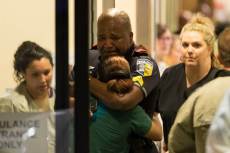 Dallas, you are in my heart and on my mind. I am praying for the people who reside within the boundaries of this great city, and those who live in the suburbs. I’m also praying for those who do their best to serve and protect the citizens of this ever-growing metropolitan area; my heart bleeds blue for the slain officers.
 Whenever I read the opening verses of Psalm 92, the number 1,440 flashes through my mind. 1,440 is the number of minutes in a day, and Psalm 92 is a positive motivator on how to manage these precious moments:
 Where are you living? I don’t mean the place where you park your car or the address that your GPS takes you to when you touch the HOME button. Where do you live in your thoughts, fantasies, worries and wants? Is it Never Never Land or the Land of Never?
 After watching the gleefully satisfied look of the defensive players on the Broncos and Panthers, I’m adding a new classification to the list of impulse control disorders. This list usually includes dysfunctional behaviors such as kleptomania, pyromania, trichotillomania.
  Life would be boringly bland if it were not for our emotions. I’m thankful that I can scan the horizon of humanity and see faces of innocence framed in smiles that run from ear to ear. What would a party be if a child never had the gift of joy when he unwrapped a toy?
 There’s no failsafe vaccine for it, and everyone who has ever lived has felt the crushing power of the vice-like grip of Big Daddy Bad Day. The physical symptoms are nothing like the chills, sweats, and fever that typify malaria, nor the feigned symptoms of malingering. When Big Daddy slaps you down, you feel a nauseating surge of melancholy with its brooding sadness and boiling madness.
 I’ve see it happen more than once: A husband and wife stand side by side as they watch a raging fire engulf their home that housed a lifetime of memories. I’ve heard them ask: “What will we do now. How we will get through the loss of everything we’ve worked for?”
 insightbyseymour