A Plea For Help

According to a story on Yahoo, while Julie Keith was unpacking some decorations she found a letter hidden in the packing material. Apparently the letter was from the Chinese laborer who had made the decorations.

The letter was a plea for help: “Sir, if you occasionally buy this product, please kindly resend this letter to the World Human Right Organization. Thousands people here who are under the persecution of the Chinese Communist Party Government will thank and remember you forever . . . People who work here have to work 15 hours a day without Saturday, Sunday break and any holidays. Otherwise, they will suffer torturement, beat and rude remark. Nearly no payment (10 yuan/1 month).” Convert that to the monetary system of the USA, and you get about $1.61 a month. http://shine.yahoo.com/work-money/letter-chinese-laborer-pleading-help-found-halloween-decorations-202400773.html

When I read this story, I thought: How tragic! As I thought about the letter Julie Keith found, I began to see a parallel to another letter that often goes unread and unnoticed.

Most people call this “letter” the Bible. Even though it is found in the homes of many people around the world, it is often covered with the dust of neglect.

This letter from God had been translated into more than 2,000 languages and dialects. In 1998, worldwide distribution through the combined efforts of Bible Societies totaled 20.8 million complete Bibles, 20.1 million New Testaments, and 19.4 million portions of at least one book of the Bible.

The best known passage of the Bible may be John 3:16: For God so loved the world that he gave his one and only Son, that whoever believes in him shall not perish but have eternal life (NIV).

Another version of this passage is found in The Message: This is how much God loved the world: He gave his Son, his one and only Son. And this is why: so that no one need be destroyed; by believing in him, anyone can have a whole and lasting life. God didn’t go to all the trouble of sending his Son merely to point an accusing finger, telling the world how bad it was. He came to help, to put the world right again. Anyone who trusts in him is acquitted; anyone who refuses to trust him has long since been under the death sentence without knowing it. And why? Because of that person’s failure to believe in the one-of-a-kind Son of God when introduced to him.

Why not find your copy of God’s letter to You? Dust it off; flip through the pages; and, you will find another plea. It is a plea not for help, and an offer to help: Are you tired? Worn out? Burned out on religion? Come to me. Get away with me and you’ll recover your life. I’ll show you how to take a real rest. Walk with me and work with me—watch how I do it. Learn the unforced rhythms of grace. I won’t lay anything heavy or ill-fitting on you. Keep company with me and you’ll learn to live freely and lightly (Matthew 11:28-30 MSG).

Every time I read this letter, I find plenty to keep me thinking.

Now I Understand

I’ve been the pastor of FCC for some 25 years, and I now understand what one of my mentors said to me many years ago:  “Stan, one of these days you will have a long pastorate, and you will find that funerals get harder to do.”

At the time that statement was made, I just brushed it off as the words  of a sentimental old man.  The longer I pastor FCC, the more I understand those words.  I guess I have become like that sentimental old man.

Over the last couple of years, I have  bid farewell to many very good men.  These are men who have served by my side as the elders and deacons of the church.  Over the last couple of years, the corners of my eyes have glistened with the tears of grief and gratitude as I have paid tribute to men like Dale, Ernie, Wilford, and just this week Gayle.

In Proverbs 25:1, Solomon wrote:  A word fitly spoken is like apples of gold in pictures of silver.  I’ll put a little spin on those words to say that these men fitly lived there lives in such a way that they were the apples of gold in the pictures of silver.

All this reminiscence has left me with that glistening moisture in the corner of my eyes, so this sentimental old man will end with plenty to keep me thinking. 

A GPS for Christmas

Getting to where I want to go is much easier than it used to be.  With the advent of the GPS and the “On Star” technology that is a standard with many new vehicles, it is easier to get from Point A to Point B.

Earlier this week, I was trying to help a person find her way from one place to another, and she said:  To get anywhere, I about need to know where I’m going.

Have you ever asked yourself that question?  Do I know where I am going?  Along with this question, perhaps we also need to ask:

  • Where will this emotion take me if I allow it to control me?
  • How beneficial is this compelling desire to my overall well-being?
  • If I continue to steal from my employer, what will happen if I lose my job?
  • If I allow myself to compromise my ethics and my morals, what will happen to my family?

Perhaps one of the most important questions a person should ask of himself is:  Where am I going when I die?

The good thing about this question is the 3 letters GPS.  I’m not speaking of a Global Positioning Satellite, but rather of God’s Personal Search.

GPS is the real meaning of Christmas.  Jesus was born in such an extraordinary fashion in a so humble place, so He could come to seek and to save the lost (Luke 19:10).

Are you getting to where you want to go?

A Not So Sly Foxx

At the recently held 2012 Soul Train Awards in Las Vegas, Academy Award winning actor Jamie Foxx called President Barack Obama “our lord and savior.”

When I watched a replay of his comments on the evening news, I thought of a verse from the Old Testament:  God is not like people. He tells no lies. He is not like humans. He doesn’t change his mind.  When he says something, he does it.  When he makes a promise, he keeps it (Numbers 23:19 GWT).

According to this verse, if President Obama was God, he would keep the promises that he has made.  So Mr. Foxx can see that President Obama is not God, I’ve listed five of his broken promises:

A Broken Promise Concerning The Deficit:  “Today, I’m pledging to cut the deficit we inherited in half by the end of my first term in office.” — Obama, Feb. 23, 2009

A Broken Promise Concerning The Closing Guantanamo:  “Guantanamo will be closed no later than one year from now.”— Obama, Jan. 22, 2009

A Broken Promise Concerning Immigration:  “What I can guarantee is that we will have in the first year an immigration bill that I strongly support and that I’m promoting. And I want to move that forward as quickly as possible.” — Obama, May 28, 2008

A Broken Promise Concerning Housing:  “We will help between 7 [million] and 9 million families restructure or refinance their mortgages so they can … avoid foreclosure.” — Obama, Feb. 18, 2009

 A Broken Promise Concerning Israeli-Palestinian Peace:  “We should reach for what’s best within ourselves. If we do, when we come back here next year, we can have an agreement that will lead to … an independent, sovereign state of Palestine, living in peace with Israel.” — Obama, Sept. 23, 2010

I doubt that Mr. Foxx will read this blog, but if he does I hope he can discover there is a difference when it comes to the message of just a man and the ministry of the Messiah.  When Jesus spoke, His words were words of substance, and He was full of grace and truth (John 1:14).

The Miracle of St. Nick

In December of last year, Phillip Bump wrote an article for The Atlantic that examined the Christmas Eve workload of the jolly old elf.  Using data from the CIA, Bump focused his article on Santa’s deliveries to the world’s 526,000,000 Christian kids 14 years of age and younger.

Bump determined that Santa would need to “deliver presents to almost 22 million kids an hour, every hour, on the night before Christmas. That’s about 365,000 kids a minute; about 6,100 a second.”  In the spirit of Christmas and in child-like faith, Bump concluded this is “Totally doable,” and later in the article, he said:  “If anyone ever desired sainthood, it is Nick.”

The anticipation of Christmas is hard to contain when you’re a child.  I can remember how quickly I hurried home after school so I could watch Santa’s Workshop on a black and white TV.  The days from Thanksgiving to Christmas passed by with the agonizing speed of a turtle.

As a child, I thought Christmas would never come; and, truthfully, I gave very little thought to its significance.  The desire that I had for the brightly wrapped gifts carefully placed beneath the bright lights and icicles hanging on the Christmas tree, had little to do with the Christ of Christmas.

So, what is Christmas?  It certainly isn’t big box stores opening on Thanksgiving Day to celebrate the birth and arrival of frenzied shopping.  Christmas is the birth of Hope.  It is a time to step away from the hustle and bustle of the mobs and the malls to find a moment of solitude to reflect on what God has done for us.

Christmas is that day long ago when Jesus stepped down from the glories of heaven to be born in a lowly manger; to live a sinless life; to die the death of the cross; to rise again on the third day, and to return to heaven to intercede on our behalf.

The Apostle Paul summarized the life of Christ, when he wrote:    Beyond all question, the mystery from which true godliness springs is great:  Jesus appeared in the flesh, was vindicated by the Spirit, was seen by angels, was preached among the nations, was believed on in the world, was taken up in glory            ( I Timothy 3:16).

Pilgrim Thought

Since Thanksgiving will be observed later this week, it might be good to consider the fundamentals of Scripture that influenced the thoughts of the Pilgrims.  This persecuted group of believers used the principles of the bible as a guide for their lives.  When they read the 10 Commandments, they believed they were exactly that—commandments and not suggestions.

There are some who would argue that morality in itself is a basis for belief in God.  When we speak of a moral argument for the existence of God, it does not mean:

• that a person must believe in God to be moral

• that if a person would ever stop believing in God that he would revert to immoral behavior

• that morality originates from the Bible or that we need religion to be moral

The moral argument is based on the concept of objective moral standards:   Absolute right and wrong exist, and we know this internally.   Does a child need the 10 Commandments to know it is wrong to steal.?  No,  he knows this before he can ever read and cries loudly when he senses he has been wronged.

What about murder?  We don’t need to be taught that murder is wrong, and we don’t need to read the 10 Commandments to know it is wrong; we intuitively know that it is wrong.   The 10 Commandments simply reinforce, in a profound manner, the moral imperatives that we instinctively know to be true.

Those who object to the concept of the moral argument might question:   “If morality is absolute, why do we see so much evil in the world?” To label certain actions as “evil” is to imply the existence of objective moral standards. If there is no moral standard, how can anything be good or evil?

The Pilgrims experienced religion at its worst and suffered in their quest for freedom to worship without the interference of the government.  Because they had the audacity to possess an English bible, read it, and teach it, some of them were burned and others were imprisoned.  It was this sort of corrupted religion that was the motivator for John Bunyan to write Pilgrim’s Progress.

To state it more simply, the moral argument is the realization that there is something in us that insists on right action for the benefit of self and the betterment of all living things.  When the Pilgrims insisted on right action, they were persecuted.  To escape the heavy hand of the Church of England, they eventually made their way to the shores of a new land where they worshipped the God of the bible.

For this, I give thanks . . .

National Monument to the Forefathers

When I reach this point on the calendar each year, my thoughts turn towards Thanksgiving.  I must confess that I think of turkey, candied sweet potatoes, and pie.  More accurately I should say pies—cherry, pecan, and apple.

I think about more than just food.  I also think of the sacrifices of our Forefathers.  Daniel Webster commended the sacrifices of the faith-filled and hardy Pilgrims when he said: Our fathers were brought here by their high veneration for the Christian religion. They journeyed by its light, and labored in its hope. They sought to incorporate its principles with the elements of their society, and to diffuse its influence though all their institutions, civil, political, or literary.

The sacrifices of our Forefathers are memorialized in the Forefathers Monument.   This monument is the largest granite structure of its kind in America. It stands an imposing 86 feet high and weighs 180 tons.

It is appropriate that at the center of the monument onlookers see a classically draped female entitled Faith. Her right hand is lifted towards heaven and her left hand holds the Bible of the Pilgrims, the Geneva Bible.  She stands 36 feet tall, and she is posed with one foot on Plymouth Rock.

Lady faith reminds us of the faith of our Forefathers.  Their faith was the source of their strength as they struggled to embrace the liberties and freedoms they envisioned.   Their faith sustained them and guided through times of heartaches and trials.

Let me share another quote from Daniel Webster:  Let us develop the resources of our land, call forth our powers, build up its institutions, promote all its great interests, and see whether we also, in our day and generation, may not perform something worthy to be remembered.

When Webster spoke of his day and his generation, I think he was comparing it to what the Forefathers had done.  I wonder:  How does the commitment of our present generation look in comparison?

When you give thanks on Thanksgiving, remember to thank God for the generation of our Forefathers.

Marriage and the Middle Class

I received my copy of Propositions in the mail today, and the title caught my attention:  What’s Missing From Our Middle Class Debate?  The author, Barbara Dafoe Whitehead, has a long list of credentials, including her 9 year stint as co-director of Rutger’s National Marriage Project.

In her discussion of the dwindling middle class, Whitehead cites a recent study by the Pew Research Center.  The data from this study suggests that a decline in marriage is directly correlated to the decline in the middle class.

Whitehead also speaks of the relationship between unwed motherhood and moderately educated mothers:  “As fewer moderately educated Americans are able to form lasting marriages, their family lives become more difficult.”

The author refers to marriage as the “prudential institution” of our nation’s long history, and she sees it as “the means by which individuals who are not born to great fortune or favor can form a cooperative union to share responsibilities of a family household and especially the tasks of nurturing and educating children.”

Whitehead concludes her essay with two questions that are worthy of our consideration: (1)  Can we realistically hope to rebuild the middle class while accepting the continuing decline of marriage, the very institution on which our middle class most clearly depends? (2)  Can we Americans realistically hope for a middle class majority if we no longer hope and strive for a married majority?

I have always believed that the family is the load-bearing pillar of American society.  As such, we should give some contemplation as to what we can do to strengthen it.

A Picture Is Worth a . . .

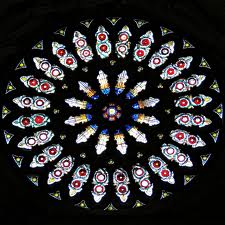
The photo to the right is a picture that speaks of intricate design.  It is a picture of the famous Rose Window in the York Minister Cathedral in England.

The window was designed to celebrate the marriage of King Henry 7th and Elizabeth of York. This marriage finally brought an end to the ‘Wars of the Roses’ that had divided British feudal nobility between the years of 1450 and 1485.  This marriage joined the House of Lancaster to the House of York and brought peace to the two families and eventually gave birth to Henry 8th.

The picture to the left is equal in beauty to the top photo, and it also speaks of complex design.  The curious thing about these two pictures is that when people see the Rose Window they stare at its beauty and ask questions that focus on the person who designed the window.

When people look at the picture to the left, some are perplexed to learn that it is a vertical cross-section of human DNA:  The human race that some say is the product of chance.

Would you believe that the Rose Window and the York Minister Cathedral just spontaneously appeared without a designer?  I doubt it.

How, then, can a person say that the human race with 3.1 billion bits of information in the DNA was not designed?

I  believe this is a case where  a picture really is worth a thousand words.

Inflection Points

An inflection point can be defined as a moment of dramatic change, especially in the development of a company, industry, or market (American Heritage Dictionary).  Wall Street defines an inflection point as a point on a chart that marks the beginning of a significant move either up or down.

Due to the stress and strain of the moment,  inflection points can be hard to recognize in the present; and, they are more easily seen from the perspective of history.

A significant inflection point in the Old Testament involves the Hebrew nation and its long awaited and highly anticipated move into the Promised Land.  Instead of crossing into the land of milk and honey, they chose to hunker down in a dust-choking, water deprived wilderness.

The dramatic change in the life of this fledgling nation occurred when they listened to the report of 12 spies when they returned from a secretive mission.  The majority report was given by 10 spies:  There are giants in the land, and we look like grasshoppers in their sight.  The minority report was given by Joshua and Caleb, and they spoke of the vast resources of the Promised Land, and said, let’s claim the promise.

Their decision changed the course of history.  They acted on the minority report and instead of going up and forward, they went down and back.  As a result of believing the minimalist view, every one of the 12 spies died . . . everyone except 2 of them:  Joshua and Caleb lived and continued to play an influential role in birthing a new nation.

The older generation continued in their resistance and died in the wilderness, but Joshua and Caleb continued in their persistence.  Even though their bodies aged, their faith was renewed each morning as step by step they moved forward to possess the promise of God.

Looking back through the pages of Scripture, I see several inflection points:

  • When Andrew met Jesus, he found his brother Peter and took him to Jesus.  This inflection point led to dramatic changes in the lives of many people.
  • When David decided to leave the battle to his soldiers to peek into the private life of Bathsheba, he changed the course of many lives. Innocent people died and others suffered consequences that were not of their own making.
  • Paul’s sad epitaph in regard to Demas is haunting words:  Demas has forsaken me, loving the present world more than the one to come. What decision led to this dramatic change?

When faced with a crisis or a major decision, I encourage you to listen to the counsel of Solomon:  There is wisdom in a multitude of counselors.

When you meet an inflection point, ask yourself a couple of questions: [1]  What will Mother or Grandmother think of my behavior when they hear of this?  [2] What will happen when my actions make the front page of the newspaper and my picture is on the evening news?

What is the source of your strength and what principles of truth guide you when your life intersects with an inflection point?  I hope this is enough to keep you thinking.