
The Sound of Spring

finchI always look forward to the coming of Spring; its arrival is heralded with the song of yellow finch as they eat from the thistle filled feeder hanging from a tree. They are often joined by their redheaded cousins, and cardinals eat from another feeder close by.

These brightly colored birds do something that we generally associate with human activity. I’m speaking of praise and worship. In Psalm 148:1-4, it is clear that God’s creation is to actively praise Him. When you skip down to verse 7, it suggests that the song of the bird is an act of praise to God.

The Psalm closes with these words: “Let them praise the name of the Lord, for his name alone is exalted; his splendor is above the earth and the heavens. And he has raised up for his people a horn, the praise of all his faithful servants, of Israel, the people close to his heart. Praise the Lord.”

I want to encourage you to give some consideration to what you say today. When you make a choice of words, make sure they are choice words.

Your choice of words will define you. Are you known more for your tongue lashings or for your words of grace and encouragement?

This was the centerpiece of James thoughts when he said: “For every kind of animal, bird, reptile, and sea creature is subdued and has been subdued by humankind. But no human being can subdue the tongue; it is a restless evil, full of deadly poison. With it we bless the Lord and Father, and with it we curse people made in God’s image. From the same mouth come blessing and cursing. These things should not be so, my brothers and sisters. A spring does not pour out fresh water and bitter water from the same opening, does it? Can a fig tree produce olives, my brothers and sisters, or a vine produce figs? Neither can a salt water spring produce fresh water (3:7-12)”

Birds sing because they have a song, and you should praise God because he has put a new song in your heart.

Psalm 40:2-4: “He also brought me up out of a horrible pit, out of the miry clay, and set my feet upon a rock, and established my steps. He has put a new song in my mouth—Praise to our God;
Many will see it and fear, and will trust in the LORD. Blessed is that man who makes the LORD his trust, and does not respect the proud, nor such as turn aside to lies.”

Rubber Ducky

121-pack27-021514-tmCanard is a French word that means duck, but to understand the true meaning of “canard,” you need to consider its older context. The French phrase, “vendre des canard a moitie, means “to sell ducks by half.”

As the story goes there was one merchant in a town who sold ducks. Everything went well until a second merchant entered the market, and he started a bidding war. The price went from 8 Francs to 7 and down to 6. The original duck merchant became frustrated, so he advertised: “Ducks for Two Francs.” However, in small print at the bottom of the advertisement, it read: “for half a duck.”

The word “canard” became associated with something that was literally true, but also misleading. Canard is now used in reference to trickery, deceit, or a hoax.

Paul warns us of canards: “We should no longer be children, tossed to and fro and carried about with every wind of doctrine, by the trickery of men, in the cunning craftiness of deceitful plotting (Ephesians 4:14).

Flash back to the Garden of Eden and the serpent’s persuasive little chat with Eve that had resounding repercussions. In this conversation, Satan employed deceptive language to create doubt in the mind of Eve: “Has God indeed said, ‘You shall not eat of every tree of the garden’?”

“Indeed,” as used here, is a word of innuendo; Satan was saying: “You’ve got to be kidding! Only a crazy person would limit your freedom and say you can’t have something that is so good for you.” This was a tactic to kindle Eve’s smoldering desire.

And, desire never reads the fine print. James spoke of the subtle power of desire: “Each one is tempted when he is lured and enticed by his own desires. Then when desire conceives, it gives birth to sin, and when sin is full grown, it gives birth to death (1:14, 15).”
Did you notice the two words preceding “desires?” They are not “your neighbor” or “your friend.” They are: “his own.” What may tempt me may be of no concern to you, but both of us are responsible to control the desires that urge us on.

Ray Stedman has an interesting comment on this:
The first step the Devil takes with us is always to arouse desire to do wrong, to create a hunger, a lure or enticement toward evil. The second is to permit intent to form and an act to occur. This is what James describes as “desire when it has conceived bringing forth sin.” Notice that the symbol he employs is that of conception and birth. There is a gestation period in temptation, for once desire is aroused there occurs a process within which sooner or later issues in sin, an act that is wrong. The third stage is that the Devil immediately acts upon the opportunity afforded by the evil act to move in and to produce results which Scripture describes as death — “Sin when it is full-grown brings forth death.”

If you want to give a little more thought to this subject, think about how Satan tempted Eve in connection to the two” lusts” and one “pride” in I John 2:15-16.

Connecting the Dots

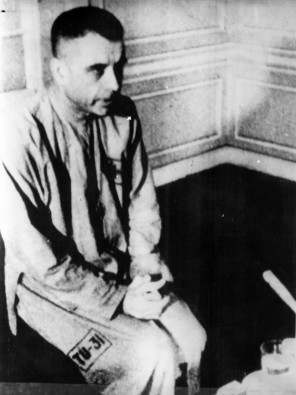
dentonIf you are too young to remember the Vietnam War, you may not be familiar with a brave and courageous man. His name is Jeremiah Denton, and I was saddened when I read of his death last week.

The service of U.S. Navy Comdr. Jeremiah A. Denton, Jr., was nothing short of remarkable. As the pilot of an A-6 Intruder, he led bombing runs over North Vietnam. On July 18, 1965, he was shot down and taken prisoner.

While at the Hanoi Hilton, his captors intended to use him in a propaganda statement that would denounce the American war effort and praise the Viet Cong for their humane treatment.

Denton’s words were not as important as his actions. He said: “Whatever the position of my government, I believe in it, yes, sir,” he said. “I am a member of that government, and it is my job to support it, and I will as long as I live.” While he was speaking these words, he was also sending a Morse code message by blinking his eyelids:
T: – O: – – – R: • – • T: — U: • • – R: • – • E: • By connecting the dots, Denton’s message made sense.

When I think of the tenacious spirit of Denton, I’m reminded of Paul’s call to commitment: “ . . . run with endurance the race set out for us, keeping our eyes fixed on Jesus, the pioneer and perfecter of our faith. For the joy set out for him he endured the cross, disregarding its shame, and has taken his seat at the right hand of the throne of God. Think of him who endured such opposition against himself by sinners, so that you may not grow weary in your souls and give up (Hebrews 12:1-3).”

One reason Denton persevered was because he connected the dots. He “fixed” his eyes on Jesus. “A man,” Denton said, “does a lot of praying in an enemy prison. Prayer, even more than sheer thought, is the firmest anchor.”

When the winds of adversity roar through your life at a dizzying speed, what is the anchor of your soul?

Note: I encourage you to watch the short video of Denton’s interview by clicking here.